
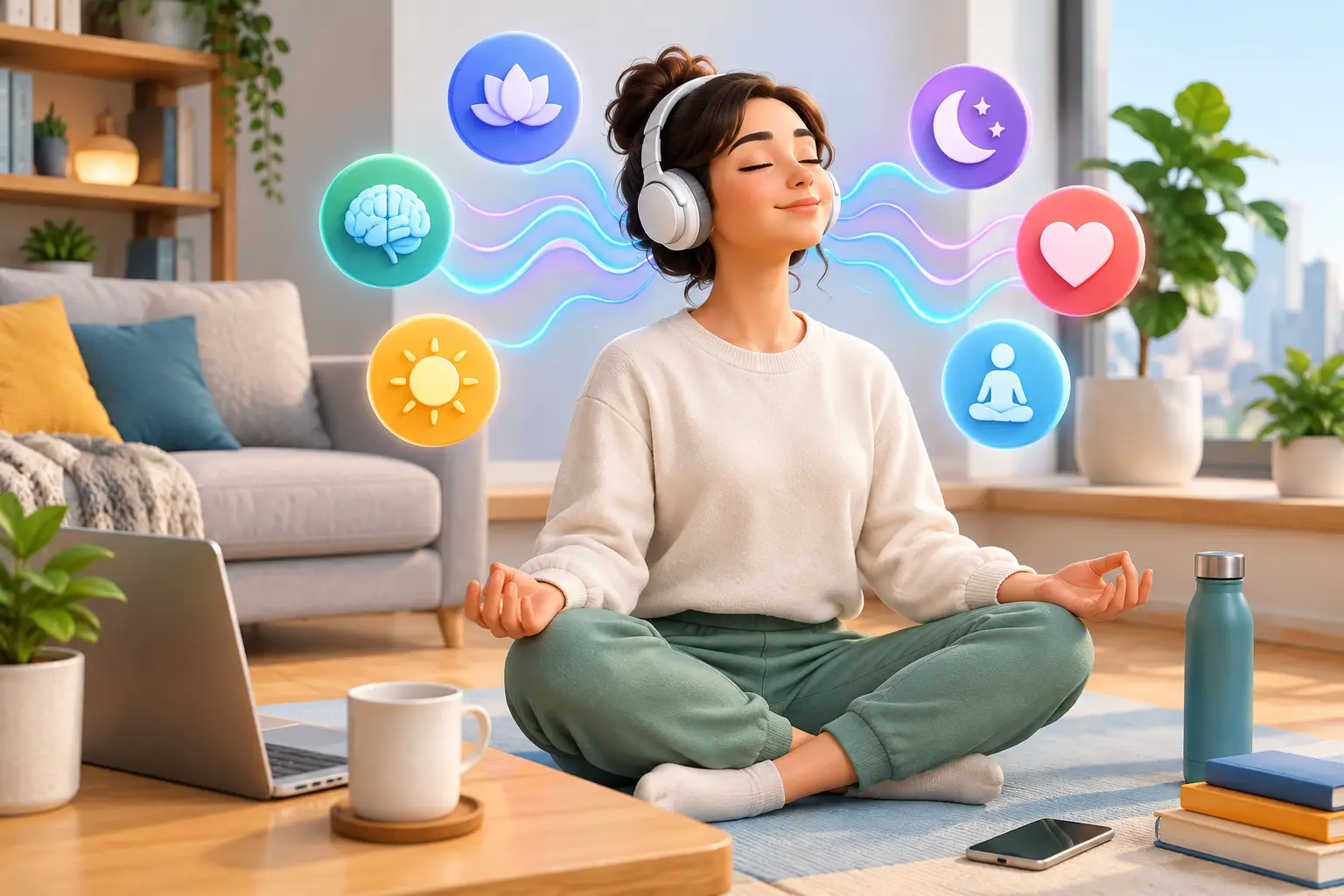
Your brain already responds to sound. A crowded cafe can scatter your attention. A favorite song can shift your mood in seconds. Sound based self improvement takes that natural response and turns it into a deliberate daily tool - one you can use before a demanding work block, after a stressful conversation, or when your mind refuses to settle.
The goal is not to find one track that magically fixes everything. It is to build a reliable audio routine that helps you move into the state your next task requires: focused, calm, energized, reflective, or ready to rest. Binaural beats can be a powerful part of that routine because they are designed for intentional listening, not passive background noise.
What Sound Based Self Improvement Actually Means
Sound based self improvement is the practice of using audio to support mental, emotional, or behavioral goals. That may include music for motivation, ambient sound for concentration, guided audio for relaxation, or binaural beats for creating a more intentional listening environment.
Binaural beats work differently from ordinary music. When each ear receives a slightly different tone through headphones, your brain perceives the difference between those tones as a rhythmic pulse. For example, a tone of 200 Hz in one ear and 210 Hz in the other creates a perceived 10 Hz beat. Listeners often use these patterns as part of a focus, meditation, relaxation, or sleep-preparation practice.
The key word is support. Audio is not a replacement for sleep, medical care, therapy, movement, or the practical systems that keep your life on track. It is a low-friction tool that can help reduce the mental resistance between where you are and what you need to do next.
That distinction matters. The best results usually come from pairing sound with an action. A focus track becomes more useful when it starts the same deep-work ritual every morning. A calming track becomes more effective when it marks the end of your workday and the beginning of recovery.
Why Audio Can Change Your State So Fast
Your attention has limited bandwidth. Every notification, unfinished task, tense conversation, and open browser tab competes for it. Intentional audio gives your brain a consistent sensory cue. Over time, that cue can become associated with a specific mode of operation.
This is less about forcing productivity and more about reducing friction. If you hear the same style of sound every time you begin a 45-minute study session, you are giving yourself a repeatable signal: it is time to work. You do not need to negotiate with yourself for ten minutes before starting.
For many people, the value is also practical. Audio travels well. It can support a morning routine, a commute, a gym cooldown, a writing sprint, or a nighttime wind-down without adding another course, device, or complicated protocol to your schedule.
But the effect depends on context. A track that feels grounding after work may feel too slow during an afternoon deadline. A high-alert focus session may be useful for analysis but distracting for creative brainstorming. Personal response matters more than hype.
Use Binaural Beats With a Clear Outcome
Random listening is fine for entertainment. Self-improvement listening needs a target. Before pressing play, ask one simple question: What state do I need right now?
For focused work
Use headphones and choose a time when you can protect your attention for at least 25 minutes. Put your phone out of reach, define one task, and start the audio at a comfortable volume. Do not expect the track to overcome a chaotic environment or a task with no clear next step. It works best when your workspace and intention are already pointed in the same direction.
A useful test is whether you return to the task faster after drifting. Focus is not never getting distracted. It is shortening the time between distraction and re-engagement.
For stress reset and emotional balance
When your system is activated, trying to think your way out of stress can create more pressure. Sound gives you something simple to anchor to. Sit down, lower the lighting if possible, and listen without multitasking for 10 to 20 minutes. Let your breathing slow naturally rather than trying to perform relaxation perfectly.
This can be especially useful as a transition after work. Many people carry the mental pace of meetings, deadlines, and messages straight into the evening. A dedicated audio reset creates a boundary, even when your schedule does not.
For sleep preparation
Use audio before bed as a cue to downshift, not as another thing to optimize. Keep the volume low and avoid pairing your wind-down track with scrolling or late-night email. If you use binaural beats, headphones are generally needed for the intended stereo effect, so prioritize comfort and safety. For some listeners, speakers or other non-headphone relaxation audio may be a better fit at bedtime.
If persistent insomnia, anxiety, depression, or other symptoms are affecting daily life, sound tools can be supportive but should not delay professional care.
Build a Routine Instead of Chasing a Feeling
The fastest way to make sound useful is to assign it a job. Give one audio category to each recurring moment in your day: a start-work cue, a stress-reset cue, and a wind-down cue. This prevents the common mistake of spending more time searching for the perfect track than actually using one.
Start small. Commit to five sessions a week for two weeks. Use the same type of audio for the same purpose, at roughly the same time when possible. Then evaluate your experience with real questions: Did I start tasks with less resistance? Did I stay with them longer? Did I recover more easily after stress? Did my sleep routine feel less restless?
Avoid judging a session solely by whether you felt an immediate dramatic shift. Some days, the win is simply sitting down and giving your attention a container. Consistency creates the data you need to decide what is genuinely helping.
A structured library can make this easier. Hertzbox Pro organizes a broad collection of binaural beat experiences around practical needs, so you can choose an intention and begin rather than getting lost in endless options. The right track is not necessarily the most intense one. It is the one you will use consistently for the state you want to practice.
Common Mistakes That Weaken the Results
One mistake is treating audio as a multitasking accessory. If a focus track is playing while you answer messages, switch tabs, and check social media, your brain learns that the cue means fragmented attention. Protect the ritual, even if it is brief.
Another mistake is using volume as a substitute for intention. Louder is not better. A comfortable level is usually more sustainable and less fatiguing, especially during longer sessions. If the sound feels irritating, distracting, or physically uncomfortable, stop and choose something else.
People also overcomplicate frequency labels. Different ranges are often associated with different listening goals, but your lived response still matters. Use claims as a starting point, not a guarantee. Track what helps you work, decompress, or prepare for rest, then repeat what earns its place in your routine.
Finally, do not expect a single listening session to erase a difficult week. Sound can help you create a better moment and reinforce better habits. It cannot remove every external pressure, solve unresolved problems, or replace recovery.
Make Your Listening More Intentional
Treat your next session like an appointment with your attention. Choose one outcome, remove one distraction, put on headphones, and give the audio enough space to do its job. Ten focused minutes can be more valuable than an hour of half-listening.
The real advantage of sound based self improvement is not that it demands more from you. It gives you a direct way to practice the state you want to access more often. Build the cue, repeat it, and let your routine become the signal that your brain is ready.