
Some audio feels passive. Some audio changes the way you work, think, and recover. When people compare isochronic tones vs binaural beats, they usually want one answer: which one gets results faster for focus, calm, sleep, or mental clarity? Start Listening
The honest answer is that both can support state changes, but they do it differently. And those differences matter if you care about performance, not just background sound. If you want audio that fits your brain, your routine, and your goal, you need to know how each method works in real use.
Isochronic tones vs binaural beats: what changes?
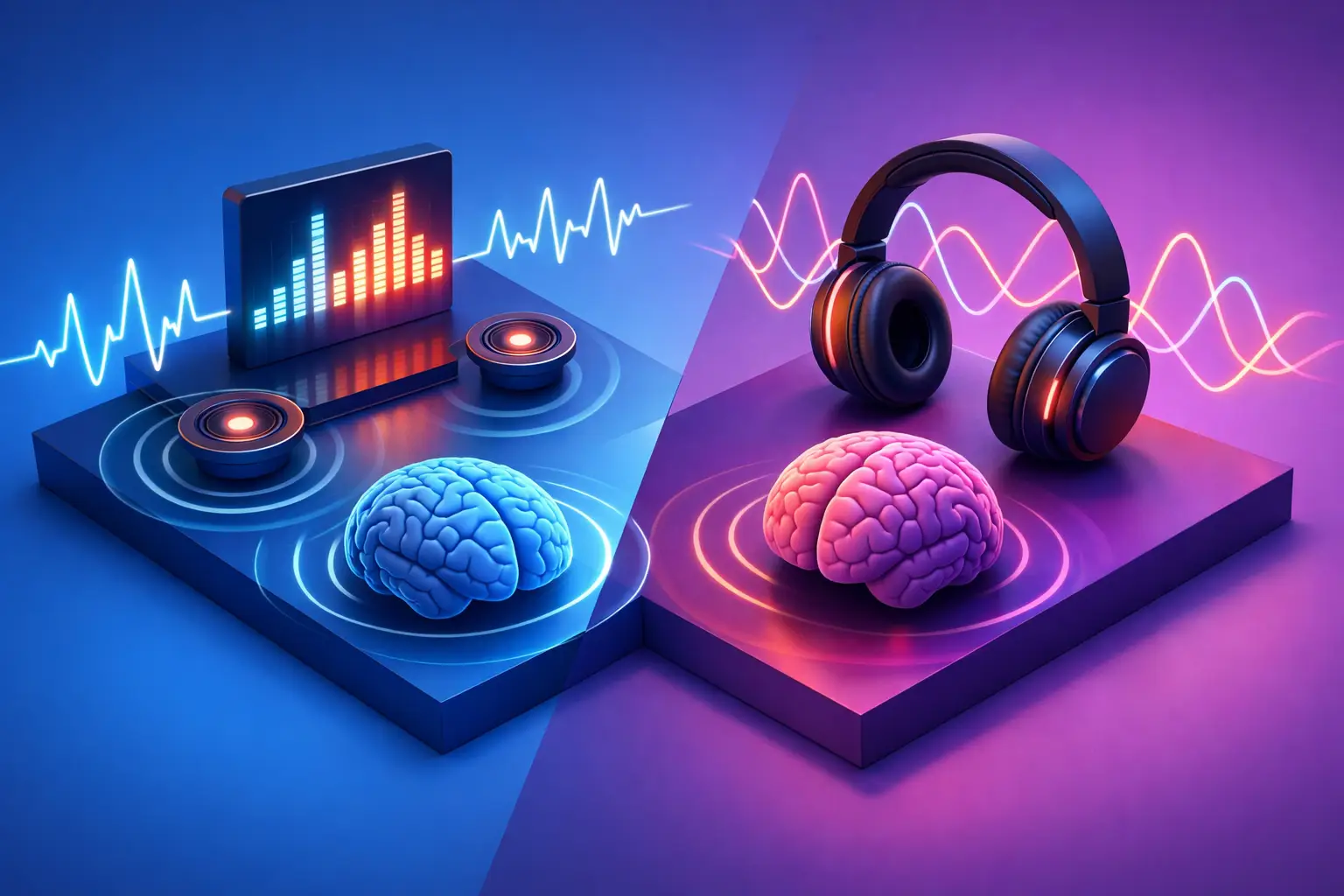
The biggest difference is in how the brain receives the signal. Binaural beats use two slightly different frequencies, with one sent to each ear. Your brain processes the difference between them as a perceived beat. That means headphones are usually essential, because each ear needs its own separate tone.
Isochronic tones work through a single tone that turns on and off in evenly spaced pulses. The rhythm is external, obvious, and much more pronounced. You can often hear the pulse clearly without needing the same left-right ear separation that binaural beats require.
That creates a different listening experience right away. Binaural beats tend to feel smoother, subtler, and easier to blend into music or ambient sound. Isochronic tones often feel sharper, more mechanical, and more direct. Some people love that intensity. Others find it distracting.
Why people respond differently
This is where a lot of oversimplified claims fall apart. There is no universal winner because people are not listening under identical conditions. A college student trying to study in a noisy apartment, a founder trying to lock in for deep work, and someone trying to wind down after a high-stress day are solving different problems.
Binaural beats often appeal to people who want a more immersive, less aggressive experience. Because the effect is subtle, they can sit underneath relaxing music, focus tracks, or sleep audio without constantly demanding your attention. For long sessions, that matters.
Isochronic tones can feel more forceful. If your goal is to create a clear rhythmic stimulus, that can be an advantage. But the same trait can also make them harder to tolerate during reading, creative work, or rest. The trade-off is simple: more noticeable does not always mean more effective for your situation.
Which is better for focus?
For focus, binaural beats often make more practical sense for daily use. Not because they are automatically stronger, but because they are easier to live with. If you are trying to work for 45 minutes, write, study, or stay mentally stable during repetitive tasks, a smoother sound profile is usually easier to sustain.
That is one reason performance-minded listeners tend to stick with binaural beats for concentration. They can support a focused state without feeling like a metronome is tapping at the edge of your attention. When the goal is mental endurance, comfort matters.
Isochronic tones can still work for focus, especially if you like a more explicit pulse and do not find it irritating. Some users say the stronger rhythmic structure helps them stay engaged. But if you are sensitive to repetitive audio textures, they may pull you out of the very state you are trying to create.
Which is better for relaxation and sleep?
This is where binaural beats usually have a clear edge in user preference. Relaxation is not just about frequency targets. It is also about whether the audio itself feels calming. Binaural beats are easier to blend into soft, cinematic, or meditative soundscapes, which makes them a better fit for evening listening, stress recovery, and sleep preparation.
Isochronic tones can support calming sessions too, but they often sound more deliberate and less natural. For someone already overstimulated, a pronounced pulsing tone may feel like too much input. That does not mean isochronic tones are bad for relaxation. It means the listening style needs to match your nervous system.
If your mind races at night, subtle usually wins over aggressive. The best sleep audio lowers resistance. It should not feel like work.
Isochronic tones vs binaural beats for beginners
If you are new to brainwave audio, binaural beats are often the easier place to start. The listening experience is more pleasant for most people, especially when paired with high-quality background sound. Put on headphones, press play, and let the track do its job.
Isochronic tones can be useful for experimentation, but they are less forgiving. If the pulsing bothers you, you will know fast. For some listeners, that directness is actually helpful because it feels more active and less abstract. For others, it is a quick no.
Beginners also tend to overanalyze whether they can "feel" the effect right away. That is the wrong test. The better question is whether the audio helps you hold the state you want with less internal friction. Better focus, easier wind-down, fewer mental jumps, calmer emotional tone - those are the outcomes that matter.
The headphone factor matters more than most people think
With binaural beats, headphones are part of the method, not an optional extra. Without separate input to each ear, the intended effect is weakened or lost. That is not a flaw. It just means binaural beats are best when you can create the right listening setup.
For a lot of people, that is completely fine. Headphones already fit into work sessions, study blocks, and evening routines. In fact, the private and immersive nature of headphone listening is part of the appeal.
Isochronic tones are more flexible in that sense. They do not depend on the same stereo separation. If you want something audible over speakers, they may be easier to use. But flexibility does not automatically equal better results. If you are already comfortable using headphones, binaural beats remain a strong choice.
What the science can and cannot promise
There is real interest in brainwave entrainment and auditory stimulation, but the marketing around it often goes too far. Audio is a tool, not magic. Neither binaural beats nor isochronic tones will replace sleep, discipline, therapy, or good work habits.
What they can do is help shape conditions. They can support attention. They can make it easier to settle into a calmer state. They can reduce the effort needed to transition from scattered to steady. For many users, that is exactly the value.
Results also depend on consistency, track quality, timing, and your baseline state. If you are exhausted, overstimulated, and checking your phone every two minutes, no frequency audio is going to carry the full load. But as part of a routine, the right track can become a powerful lever.
So which one should you choose?
If your priority is smoother listening, better integration into work and wellness routines, and a more immersive experience for focus or calm, binaural beats are usually the smarter pick. They fit modern life better. They are easier to pair with intentional routines. And for many people, they simply sound better.
If you want a more pronounced rhythmic signal, do not mind a more synthetic feel, or need something that can work without headphones, isochronic tones may suit you. They are not inferior. They are just more polarizing.
For most adults trying to improve concentration, emotional balance, and mental recovery, binaural beats offer the better balance of effectiveness and usability. That balance matters. The best audio tool is not the one that sounds most technical. It is the one you will actually use consistently because it helps you think clearer, feel steadier, or reset faster.
That is why brands built around targeted audio libraries, including Hertzbox Pro, focus on binaural beats as a practical performance tool rather than a novelty. When audio is designed around real outcomes, the goal is not to impress you with theory. The goal is to help you get into the right state on demand.
Try both if you want. Pay attention to how you feel after a week, not after one session. The right choice is the one that gives your brain less resistance and more momentum when it counts.