
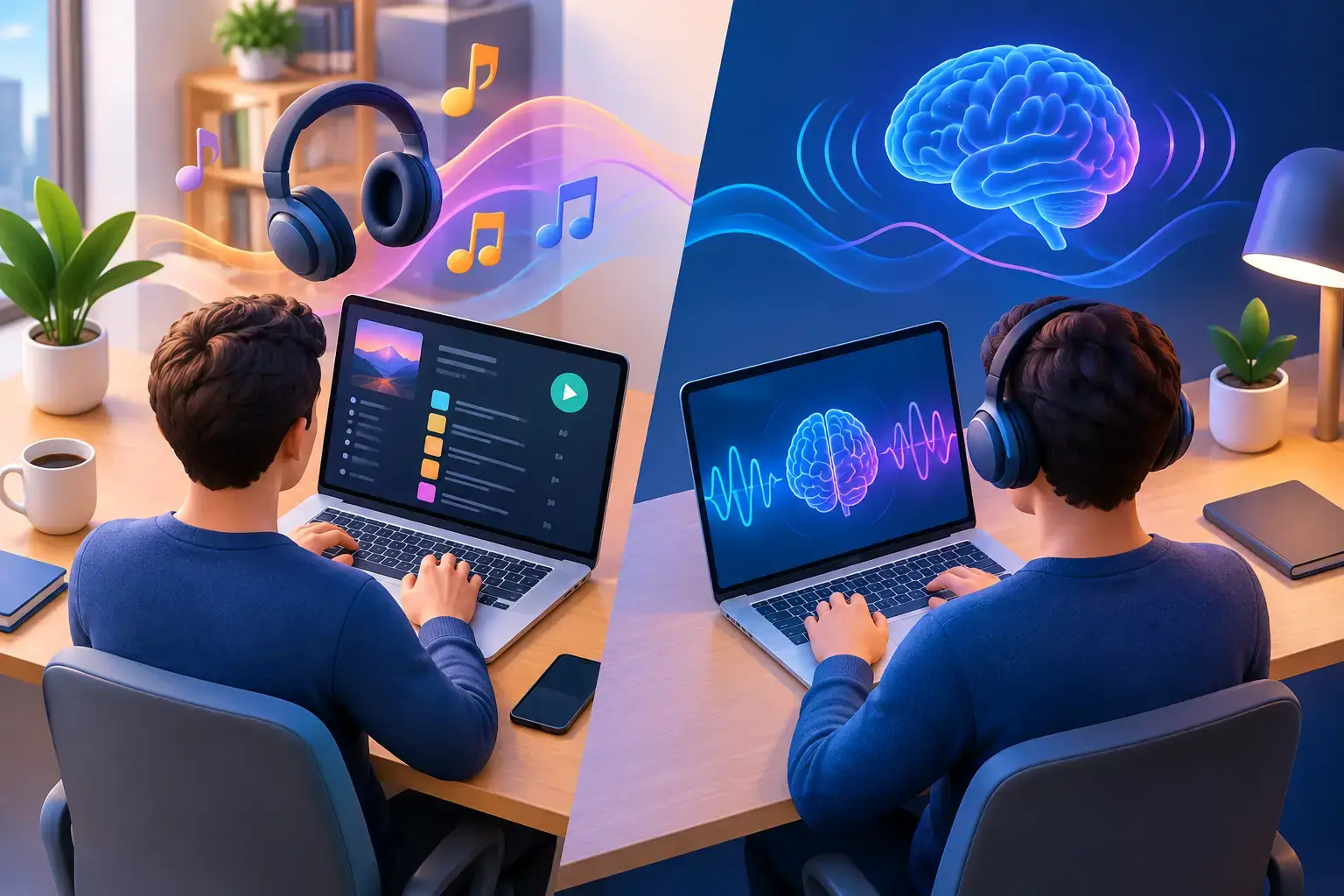
Your soundtrack can either hold your attention in place or quietly pull it apart. The real question behind focus playlists versus binaural beats is not which one sounds better. It is which one helps you enter the mental state your next task demands - and stay there long enough to make meaningful progress.
A familiar playlist can create energy, comfort, and momentum. Binaural beats are designed for something more targeted: supporting a particular internal state through stereo audio. Neither is automatically the right answer for every person or every project. But once you understand the difference, you can stop treating background sound as an afterthought and start using it as a performance tool.
Focus Playlists Versus Binaural Beats: The Core Difference
Focus playlists are built around music. They may include instrumental beats, ambient tracks, classical pieces, film scores, lo-fi hip-hop, or familiar songs with lyrics. Their effect often comes from mood, rhythm, familiarity, and personal association. A great playlist can make a long task feel lighter and reduce the urge to reach for a distraction.
Binaural beats work differently. A slightly different tone is delivered to each ear through stereo headphones. Your brain perceives the difference between those tones as a third rhythmic pulse. Tracks are typically organized around intended outcomes such as concentration, relaxation, sleep support, or emotional reset.
That distinction matters. Music asks for some degree of attention, even when you love it. A binaural beat track is generally built to stay less noticeable, so your attention can remain on the spreadsheet, chapter, proposal, or problem in front of you.
If you need motivation, a playlist may be the faster switch. If you need fewer mental interruptions, binaural beats may be the cleaner tool.
When a Focus Playlist Wins
A focus playlist can be powerful when the hardest part is simply getting started. Music gives your brain a recognizable signal: it is time to move. For repetitive tasks, chores, admin work, exercise, or a low-stakes creative sprint, the right tempo can increase energy without asking much in return.
It also works well when you are restless or under-stimulated. If silence makes you drift toward messages, tabs, snacks, or social media, music can fill that gap and make the task feel more rewarding.
The trade-off is cognitive load. Lyrics compete with language-heavy work. A song you know well can trigger memories, anticipation, or the impulse to sing along. Sudden shifts in volume, tempo, or mood can break concentration at exactly the wrong moment.
For writing, reading, studying, coding, analysis, or strategic work, use instrumental music first. Keep the playlist consistent rather than shuffling wildly. A steady sound environment gives your brain fewer new events to process.
When Binaural Beats Are the Better Choice
Binaural beats are especially useful when you are already willing to work but cannot seem to settle. You may feel mentally scattered, overstimulated, tense, or caught in a loop of switching between tasks. In those moments, more exciting music can add fuel to a mind that already has too much activity.
A focused binaural beat session gives you a simple ritual: headphones on, one task selected, notifications muted, timer started. The audio becomes a boundary between reactive mode and deliberate work.
For many people, this is where binaural beats earn their place. They are not meant to entertain you through the work block. They are meant to make it easier to remain with the work block.
Research on binaural beats is still evolving, and responses vary from person to person. They should not be treated as a medical treatment or a substitute for sleep, mental health care, or professional support. But as a non-invasive audio tool, they can be a useful part of a routine built around better conditions for concentration.
Use stereo headphones. Because each ear needs its own tone, speakers do not create the same binaural effect. Keep the volume comfortable. More volume does not mean more focus.
Match the Track to the State You Need
The biggest mistake is choosing audio based only on the task label. “Focus” is not one state.
If you feel sluggish before a morning work session, you may benefit from a track intended to support alert concentration. If your mind is racing before an exam review or a deadline, a calmer focus track may make more sense. If you are coming off a stressful meeting, start with a short reset before asking your brain to do deep work.
This is the advantage of a targeted audio library. Instead of forcing one playlist to solve every mental problem, you can choose audio based on your current state and desired state. Hertzbox Pro is built around that approach, with a structured collection of binaural beats for concentration, calm, sleep, and mental balance.
The Best Audio for Different Types of Work
Your task should make the decision easier.
For deep reading, writing, technical problem-solving, and detailed study, start with binaural beats or low-detail ambient sound. These tasks rely heavily on working memory and language processing. Lyrics and dramatic musical changes can become unnecessary competition.
For brainstorming, design work, and ideation, a gentle instrumental focus playlist can help create motion. Some people generate ideas more freely with a little emotional lift and rhythmic energy in the background.
For repetitive work such as inbox cleanup, data entry, file organization, or household tasks, use a playlist if it keeps you engaged. The work itself does not demand the same level of mental quiet, and enjoyable music may help you maintain pace.
For pre-work stress, use a calming binaural track before the task begins. Give yourself five to ten minutes to transition rather than expecting a busy brain to snap into concentration on command.
Build a Simple Audio Protocol
The goal is not to find one magical track. The goal is to reduce decision fatigue and create reliable cues for your brain.
Start by choosing one type of work you want to improve this week. It could be studying, writing, or getting through a daily planning session. Use the same audio method for several sessions before judging it. Switching tracks every five minutes turns audio into another distraction.
Try a 25- to 45-minute block with one clear outcome. Before pressing play, close unrelated tabs, silence alerts, and put your phone out of reach. Audio cannot compensate for a workspace designed to interrupt you every thirty seconds.
After each session, assess what actually happened. Did you start faster? Did you stay on one task longer? Did you feel calmer, more alert, or more distracted? Keep the measure practical. You are looking for repeatable improvement, not a dramatic sensation.
If a focus playlist makes you productive for 15 minutes and then sends you hunting for the next song, simplify it. If binaural beats feel too subtle at first, that may be the point. Their value may show up as fewer detours, not a sudden rush of motivation.
Do Not Use Audio to Ignore What Your Brain Needs
Audio can support focus, but it cannot erase sleep debt, chronic overload, hunger, burnout, or an unrealistic workload. If every sound option feels irritating, your system may need recovery more than stimulation.
Pay attention to your response. Some people prefer music for afternoon energy and binaural beats for high-focus morning work. Others use beats for studying but choose silence for writing. There is no prize for using the most technical tool. There is only the result: more of your attention spent where you want it.
The strongest move is to make your sound choice intentional. Use a playlist when you need momentum. Use binaural beats when you need to quiet the noise and lock into the next meaningful task. Then let the work become the loudest thing in the room.