
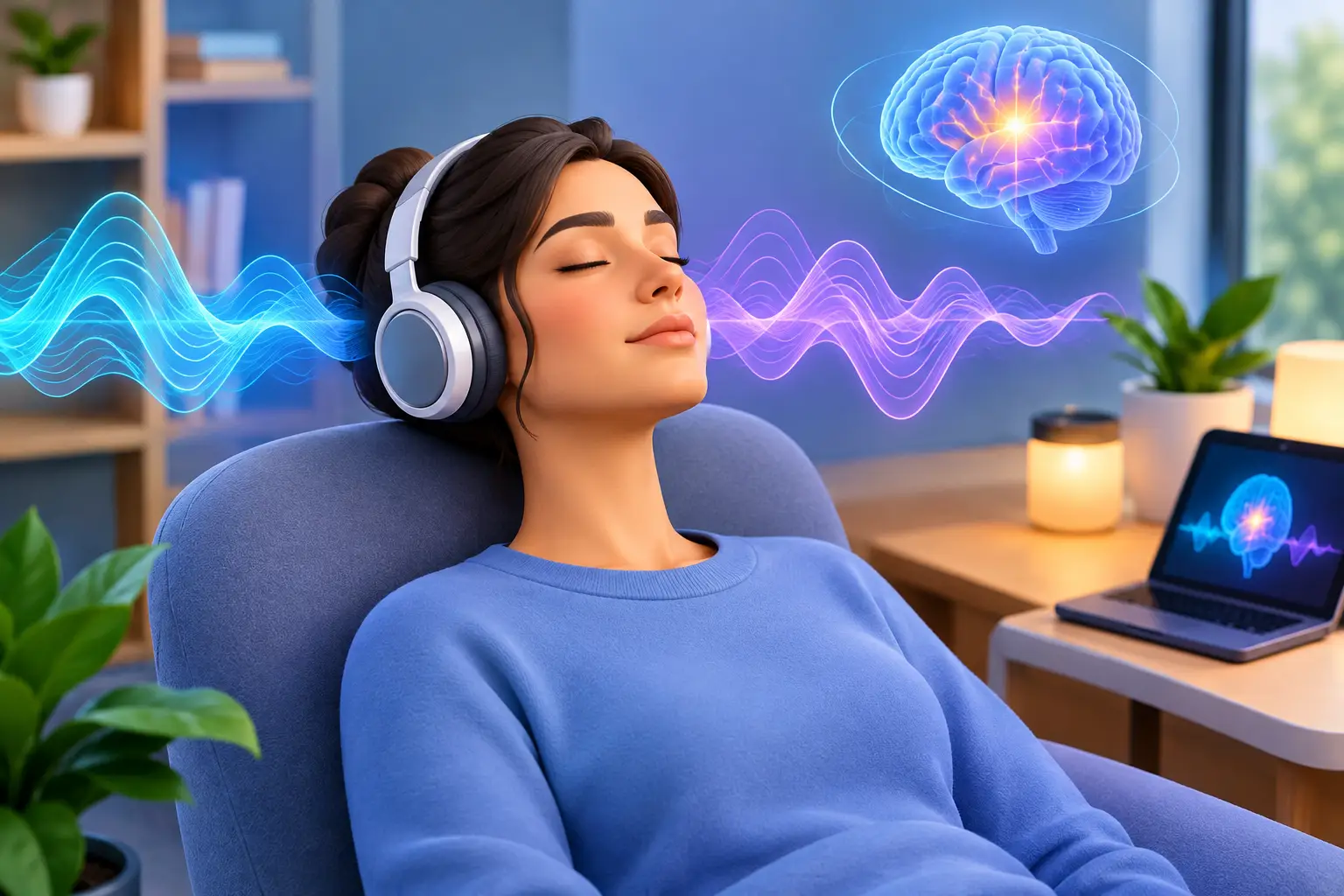
A distracted brain does not need another complicated system. It needs a clear cue that says: focus now, slow down now, recover now. That is where audio therapy research becomes useful. It helps separate realistic benefits from oversized promises and shows how sound, including binaural beats, can fit into a practical mental-performance routine. http://hertzboxpro.com
Binaural beats are not magic. They are also not just background noise. Used with the right expectations, they can be a low-friction tool for creating a more intentional environment for focus, relaxation, or emotional reset.
What Audio Therapy Research Actually Studies
Audio therapy is a broad term. It can include music therapy delivered by a credentialed professional, guided relaxation, rhythmic sound, nature audio, meditation tracks, and frequency-based recordings such as binaural beats. These approaches are not interchangeable, and the research behind them is not equally strong.
Music therapy, especially in clinical settings, has a substantial body of research for supporting emotional expression, stress management, and quality of life. Binaural beat research is narrower and more mixed. It often examines short-term changes in attention, anxiety, relaxation, mood, pain perception, or sleep readiness.
A binaural beat is created when each ear receives a slightly different tone through stereo headphones. Your brain perceives the difference between those tones as a rhythmic pulse. For example, if one ear hears 200 Hz and the other hears 210 Hz, the perceived beat is 10 Hz.
Researchers are interested in whether that perceived rhythm can influence mental state, sometimes called brainwave entrainment. The theory is compelling: certain brainwave ranges are associated with states such as calm alertness, deep relaxation, or sleep. But association is not proof that playing a frequency will reliably create a specific outcome for every listener.
That distinction matters. A performance tool earns trust when it is used for what it can reasonably do, not what marketing language wishes it could do.
What Binaural Beat Studies Suggest
The strongest takeaway from current evidence is not that binaural beats produce guaranteed transformations. It is that they may help some people shift into a more useful state, particularly when paired with a clear task, a quiet setting, and consistent use.
Focus and attention
Some studies suggest binaural beats may support attention, working memory, or task performance, especially in beta-range recordings that are often associated with alertness. Results vary widely, however. A track that helps one person settle into a productive work block may feel distracting or overly stimulating to another.
The practical value is still real. Many people struggle less with focus because a track creates a ritual. Headphones go on. Notifications go off. One priority gets their full attention. In that moment, the sound is doing more than playing. It is helping define the boundary between scattered input and deliberate work.
For deep work, start with a track at a low, comfortable volume and use it during a single 25- to 50-minute session. Do not judge it after two minutes. Judge it by whether you return to your task more easily, stay with it longer, and feel less mental friction.
Stress, anxiety, and relaxation
Audio therapy research around anxiety often shows promising but inconsistent results. Binaural beats may help some listeners feel calmer before a stressful event or during a relaxation practice. The effect may come from several factors at once: the beat pattern, the steady sound bed, reduced outside stimulation, slower breathing, and the expectation of taking a break.
That does not make the result less valuable. If a track helps you interrupt a stress spiral and create ten minutes of recovery, that is a meaningful use case. It simply means you should treat binaural beats as a support tool, not as a replacement for mental health treatment when treatment is needed.
Lower-frequency tracks are commonly used for unwinding, meditation, or pre-sleep routines. The best signal that a track is working is not a dramatic sensation. It is a subtle shift: your jaw loosens, your breathing slows, and your thoughts stop demanding immediate action.
Sleep readiness
Sleep research is especially prone to hype because everyone wants a fast off switch for an overactive mind. Binaural beats may support sleep readiness for some listeners, but they will not overcome every cause of poor sleep. Caffeine late in the day, inconsistent sleep timing, pain, alcohol, heavy screen use, and untreated sleep conditions can all outweigh a good audio routine.
Think of sleep audio as part of the runway, not the entire flight. Use it during a wind-down period, ideally while lights are low and your phone is no longer delivering fresh stimulation. If headphones are uncomfortable in bed, listen before getting under the covers rather than forcing an all-night setup.
Why Results Differ So Much
The variation in binaural beat research is not a reason to dismiss it. It is a reason to use it intelligently. Studies differ in their track design, duration, volume, participant groups, comparison conditions, and outcome measures. Some compare binaural beats with silence; others compare them with music or other audio. Those are very different tests.
Individual differences matter too. Your baseline stress level, sensitivity to sound, sleep debt, expectations, and environment can shape the experience. A 10-minute track in a noisy airport is not the same as the same track played before a planned meditation session.
There is also a measurement problem. Focus and calm are partly subjective. You may not see a dramatic score change, yet still notice that you complete your report without checking your phone twelve times. Real-world outcomes deserve attention alongside lab data.
The smart approach is simple: test one outcome at a time. Do not use a focus track, a sleep track, and a relaxation track in the same session, then try to decide what changed. Give each type of audio a clear job.
How to Use Binaural Beats With Better Results
A larger library is useful only if you can match the right sound to the right moment. Start by identifying the state you need, not the frequency label that sounds most technical.
For focused work, choose an alert but nonintrusive track and pair it with one defined task. For a reset after meetings, use a calmer track while sitting still, walking slowly, or breathing at a relaxed pace. For evening recovery, choose audio that feels less activating and protect the rest of your wind-down routine.
Stereo headphones are necessary for true binaural beat playback because each ear must receive a separate tone. Keep the volume moderate. Louder is not more effective, and listening should never feel physically uncomfortable.
Consistency gives you better information than intensity. Try the same track at the same time of day for five to seven sessions. After each session, briefly rate your focus, tension, or ease of starting on a scale of one to five. You are looking for patterns, not perfection.
Hertzbox Pro is built around this practical use: a targeted audio library lets you choose a track for the mental state you want to support instead of treating every session as an experiment from scratch.
The Limits Worth Respecting
Binaural beats should not be presented as a cure for anxiety, depression, trauma, ADHD, insomnia, or chronic pain. Research does not support that kind of certainty, and people managing these conditions deserve appropriate professional care.
Use extra caution if you have a history of seizures, sound-triggered migraines, tinnitus sensitivity, or any condition where repetitive audio may be uncomfortable. Stop listening if a track causes agitation, headache, dizziness, or increased distress. Also avoid using headphones during driving, cycling in traffic, or any task that requires full awareness of your surroundings.
The goal is not to force your brain into a state. The goal is to give your brain a better chance to enter that state. That is a more grounded promise, and it is often the more useful one.
Turn Research Into a Personal Advantage
The best audio routine is the one you will actually use when your mind is noisy, your workload is high, or your evening refuses to slow down. Research can tell you what may work. Your own repeated experience tells you whether a track earns a place in your day.
Start small. Pick one moment that regularly breaks down - the first work block, the post-meeting reset, or the hour before bed - and give it a consistent audio cue. A calmer, clearer mental state rarely arrives by accident. Build the conditions for it, then let the sound do its job.