
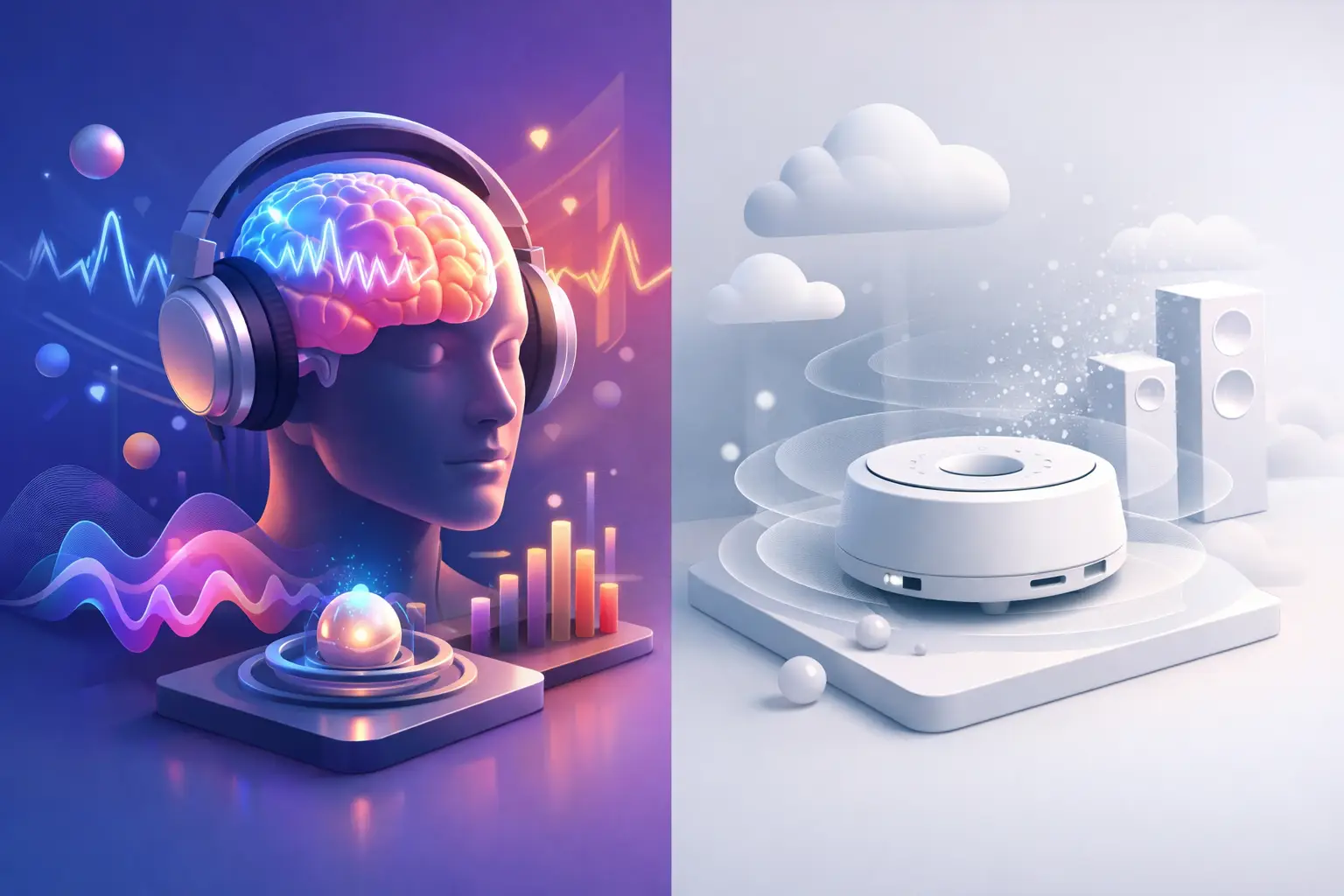
Some audio helps you tune out the world. Other audio is designed to shift what your brain is doing in the first place. That is the real difference in brainwave entrainment vs white noise, and it matters if your goal is better focus, calmer emotions, deeper sleep, or sharper mental control. Start Listening
A lot of people treat these two tools like they do the same job. They do not. White noise is mainly a masking sound. Brainwave entrainment is a targeted listening method built to influence mental state through rhythm and frequency. If you want a soundscape that covers distractions, white noise can help. If you want to guide your brain toward concentration, relaxation, or sleep readiness, entrainment has a different level of purpose.
What brainwave entrainment vs white noise really means
White noise is a steady blend of sound frequencies played at equal intensity. To your ears, it comes across as a consistent hiss or static-like wash. People use it to reduce the impact of background noise, create privacy, and make sudden sounds less disruptive.
Brainwave entrainment works differently. It uses rhythmic audio patterns, often through binaural beats, isochronic tones, or related methods, to encourage the brain to synchronize with a target frequency. Different frequency ranges are associated with different mental states. Some are linked with alert focus, some with relaxed calm, and some with drowsiness or meditative depth.
That distinction changes everything. White noise manages the environment around your mind. Brainwave entrainment aims to influence the state of your mind itself.
White noise is useful, but its job is limited
White noise has earned its reputation for a reason. It is simple, accessible, and often effective when your biggest problem is external disruption. If traffic, office chatter, snoring, neighbors, or random household noise keeps breaking your concentration or sleep, white noise can smooth out those interruptions.
This makes it a practical tool for sleep support, studying in noisy spaces, and reducing the mental irritation caused by unpredictable sounds. For some people, that alone creates a major performance boost. Better sound conditions often lead to better focus.
But white noise is not a precision tool for cognitive optimization. It does not actively push your brain toward a desired frequency state. It helps by removing friction. That is valuable, but it is indirect.
If your mind is already overstimulated, scattered, anxious, or mentally fatigued, white noise may not change much beyond making the room feel more uniform. It can create a calmer backdrop, but it usually will not feel like a deliberate mental shift.
Brainwave entrainment is built for state change
Brainwave entrainment is for people who want more than a neutral background sound. It is designed for intentional outcomes. That could mean getting into a focused work state faster, easing out of stress, improving meditation depth, or preparing the mind for sleep.
This is where binaural beats stand out. When two slightly different frequencies are played separately into each ear, the brain perceives the difference between them as a third internal beat. That perceived beat can encourage synchronization with a target rhythm. In plain English, the audio is not just filling space. It is giving your brain a pattern to follow.
For performance-driven listeners, that difference is huge. Instead of hoping a sound helps you feel better, you choose a track based on the state you want to create. Need concentration for deep work? You use a different frequency profile than you would for unwinding after a high-stress day.
That is why brainwave entrainment often feels more active and outcome-based than white noise. It is not just about blocking distractions. It is about helping your nervous system and mental rhythm move in a direction that serves the task in front of you.
Which one is better for focus?
If your problem is noise, white noise can absolutely improve focus. It reduces sudden interruptions and can make a distracting environment more workable. In a crowded apartment, open office, or campus setting, that can be enough to save a study session or work block.
But if your problem is internal distraction, brainwave entrainment usually has more upside. A busy mind is not always fixed by covering external sounds. Sometimes the issue is mental drift, low motivation, overstimulation, or difficulty settling into one task. In those cases, entrainment can be more aligned with the real problem.
This is the key trade-off. White noise is best when the barrier is outside you. Brainwave entrainment is often better when the barrier is inside you.
Many high-performers end up preferring entrainment for focused work because it feels more intentional. It gives the brain a structure, not just a shield from background noise.
Which one is better for sleep and stress?
The answer depends on why sleep is hard.
If you are being kept awake by environmental noise, white noise can be a strong solution. It smooths out barking dogs, traffic, hallway noise, and other sleep-breaking sounds. Its strength is consistency.
If you are physically tired but mentally wired, brainwave entrainment may offer more support. Stress, racing thoughts, and emotional agitation are not always solved by sound masking. Sometimes the issue is that your brain is still operating at a high-alert rhythm. Entrainment can be used to encourage a slower, calmer state that better matches rest.
The same logic applies to stress regulation. White noise can feel soothing, but it is often passive. Brainwave entrainment is more often chosen when someone wants an actual shift in internal state, not just a gentler acoustic environment.
Brainwave entrainment vs white noise for productivity
Productivity is not just about cutting distractions. It is about getting your brain into the right mode on demand.
That is where brainwave entrainment has a clear edge for many users. It fits a performance mindset because it is state-specific. You can choose tracks for focus, mental reset, calm intensity, or decompression. That makes it more flexible than white noise, which tends to do one main thing very well.
White noise is still useful during low-level work, admin tasks, reading, or sleep. But if you are trying to enter deep work, reduce inner noise, or regain momentum after mental fatigue, entrainment is usually the more strategic tool.
For people who want their audio to do more than fade into the background, this difference is hard to ignore.
When white noise may be the smarter choice
There are moments when simple wins.
White noise can be the better choice if you want a familiar, non-rhythmic sound, if you are sensitive to tonal audio, or if your main need is masking a disruptive environment. It can also work well for babies, shared spaces, and users who do not want a sound that feels directional or mentally active.
Some people also find entrainment too specific for certain tasks. If you just need neutral sound while folding laundry, working in a coffee shop, or falling asleep in a noisy hotel, white noise may be all you need.
There is no prize for using the more advanced tool when a simple one solves the problem.
When brainwave entrainment is the stronger upgrade
If your goal is mental optimization, entrainment is usually the more powerful choice. It gives you a way to match your audio to your desired outcome instead of settling for general background coverage.
That is especially true if you want better concentration, emotional regulation, meditative support, or sleep preparation. In those situations, a targeted binaural beat library can give you more control over how you feel and perform throughout the day. That is part of why systems like Hertzbox Pro appeal to people who want repeatable mental shifts without adding complexity to their routine.
The point is not that entrainment replaces every other sound tool. It is that it offers a different category of benefit. White noise manages interruption. Entrainment supports transformation.
So which one should you use?
Use white noise when the world around you is the problem. Use brainwave entrainment when your internal state is the problem.
And if both are true, be honest about your priority. Do you need acoustic cover, or do you need help shifting your mental gear? That answer will usually point you in the right direction.
The best audio tool is not the one with the most hype. It is the one that matches the result you want. If you are serious about focus, calm, and better control over your mental state, choose sound with intention and let it work for you.