
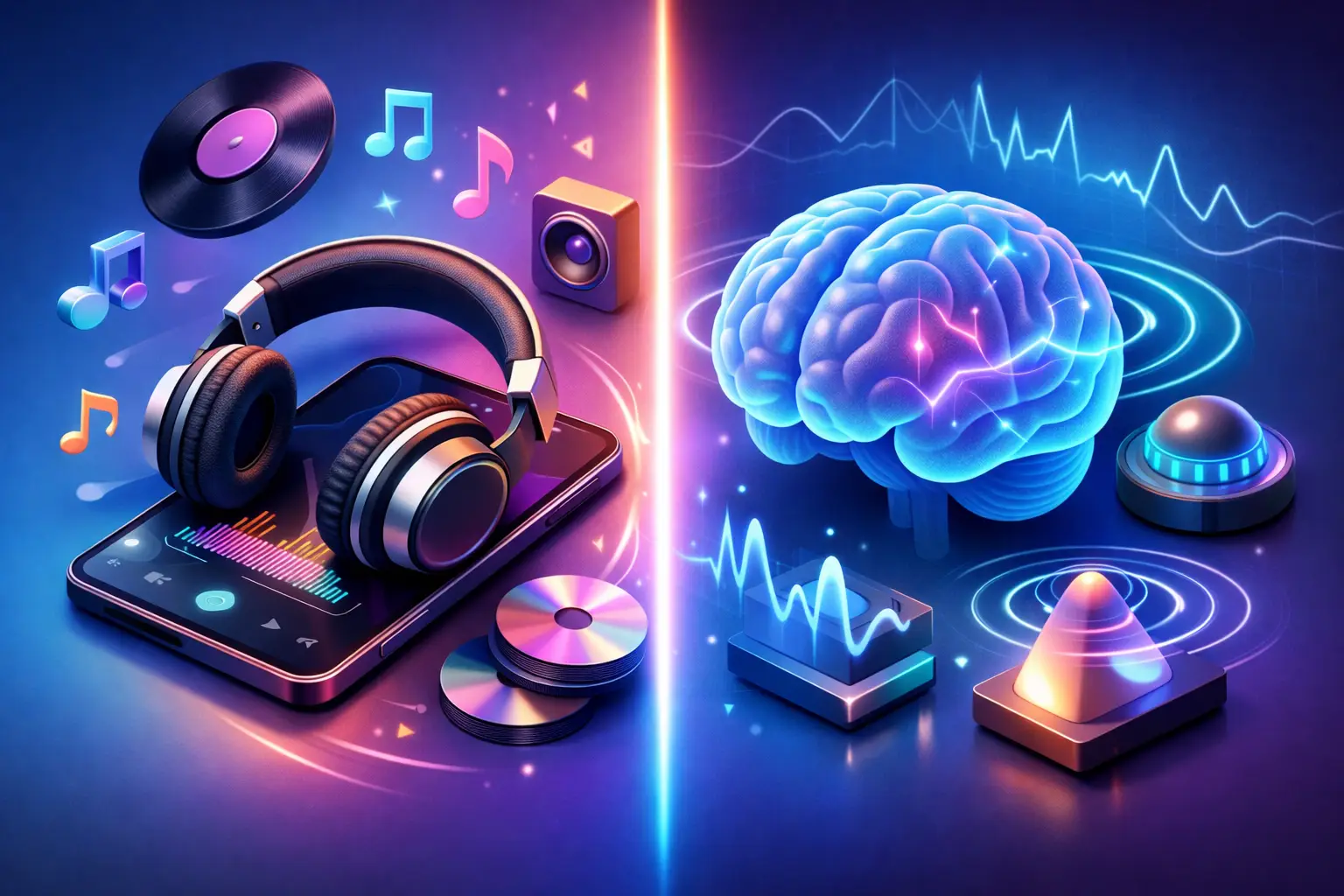
You can feel the difference within minutes. One track gives you a pleasant background and keeps the room from feeling too quiet. Another seems to change the way your mind settles, helping you lock in faster and stay there longer. That is the real question behind focus music vs brainwave audio: are you looking for atmosphere, or are you looking for a tool that actively supports your mental state? Start Listening
For a lot of people, focus music is the default. It is familiar, easy to find, and simple to turn on while you work. But brainwave audio is built for a different purpose. It is not just there to make the moment feel better. It is designed to help guide your brain toward a more useful state for concentration, calm, or cognitive control. If your goal is better performance, that distinction matters.
What focus music actually does
Focus music usually works by reducing distraction. It can cover up environmental noise, create a stable mood, and make repetitive work feel smoother. Instrumental tracks, lo-fi beats, ambient soundscapes, and cinematic background music all fall into this category.
That does not make focus music weak. In the right situation, it works well. If you are answering emails, organizing files, or doing routine tasks, a steady playlist can help you stay engaged without pulling too much attention away from your work. Music can also increase motivation, especially when you are tired or resisting the task in front of you.
The limitation is that music still competes for mental bandwidth. Even when it is subtle, your brain processes melody, rhythm, and change. For some people, that is energizing. For others, it is one more layer of stimulation. If you are doing deep reading, writing, coding, studying, or anything that demands sustained precision, that extra input can become friction.
What brainwave audio is designed to do
Brainwave audio has a more targeted job. Instead of mainly creating a mood, it aims to influence the conditions that support focus. This often includes binaural beats or related frequency-based sound patterns that are structured to encourage specific brainwave states associated with concentration, calm alertness, or mental reset.
In practical terms, brainwave audio is less about entertainment and more about function. You are not pressing play because you want something nice in the background. You are pressing play because you want your mind to become more stable, less scattered, and easier to direct.
That is why brainwave audio appeals to people who are trying to get results from their listening time. Professionals use it to reduce mental clutter before demanding work. Students use it to stay with the page longer. Entrepreneurs use it to move out of reactive mode and into controlled focus. Wellness-minded users often reach for it because it fits into daily life without adding another complicated routine.
Focus music vs brainwave audio for deep work
If your work is light, either option can help. If your work is cognitively heavy, the gap gets wider.
Focus music often supports momentum. Brainwave audio more often supports state control. That difference is huge when your main problem is not boredom but mental drift. If your thoughts keep fragmenting, if you keep checking your phone, if you sit down to work but cannot quite lock in, brainwave audio may be the better fit.
This is where people get frustrated with traditional productivity advice. They try to focus harder, force more discipline, or stack more apps on top of an already overloaded brain. But attention is not only about willpower. It is also about environment, stimulation, and internal state. Brainwave audio addresses that internal layer more directly than standard music does.
Still, it depends on the person and the task. If you are creative and think best with a bit of emotional energy in the room, music may help more. If you need calm precision and less internal noise, brainwave audio often has the edge.
Why music can help one day and hurt the next
A lot of listeners assume they need one perfect audio solution for every situation. That is usually the wrong approach.
Your brain does not need the same thing at 8 a.m. that it needs at 3 p.m. It does not need the same thing for a brainstorming session that it needs for exam prep or spreadsheet analysis. On some days, upbeat focus music can create lift and motivation. On other days, that same track feels too busy and keeps your mind bouncing.
Brainwave audio tends to be more consistent when you want a repeatable state. That consistency is a big reason performance-focused users prefer it. It gives you a more intentional listening strategy. Instead of asking, "What sounds good right now?" you ask, "What mental state do I need right now?"
That shift alone can improve how you work.
The biggest trade-off: stimulation vs control
The core trade-off in focus music vs brainwave audio is stimulation versus control.
Music usually gives you more emotional texture. It can feel motivating, immersive, and enjoyable. That makes it easier to start. If the task is boring, music can reduce resistance and help you get moving.
Brainwave audio usually gives you more mental control. It can feel cleaner, quieter, and more deliberate. That makes it easier to sustain attention once you begin. If the task is demanding, that lower-stimulation environment can help you stay steady for longer.
Neither option is automatically better in every case. The better question is what problem you are trying to solve. If you struggle to start, music may be useful. If you struggle to stay locked in, brainwave audio may be the stronger tool.
How to choose the right audio for your goal
Think in terms of outcomes, not genres.
If you need energy for shallow work, focus music is often enough. If you need calm concentration for deep work, brainwave audio is usually a smarter choice. If you feel overstimulated, mentally noisy, or emotionally scattered, music may add too much movement. In that case, a frequency-based track can create a smoother path into focus.
It also helps to match the audio to your attention pattern. Some people have wandering minds that need less sensory input. Others have low motivation and need a stronger push. Your best audio tool is the one that solves your bottleneck.
A simple test works well. Use focus music for one work block and brainwave audio for another similar block. Keep the task type as close as possible. Then notice three things: how quickly you start, how often your attention slips, and how you feel at the end. Not what sounds cooler. What performs better.
When brainwave audio makes the most sense
Brainwave audio tends to stand out when focus is not your only challenge. Maybe you are dealing with stress, emotional static, poor transition into work mode, or the feeling that your brain is on but not organized. In those cases, standard music may improve mood without solving the deeper issue.
That is where a more specialized listening tool can make a real difference. A structured binaural beat library, for example, gives you options based on the state you want to create rather than forcing one generic soundtrack onto every situation. That is a more strategic way to use audio for performance and wellness. Brands like Hertzbox Pro are built around that idea: audio not as passive background, but as a direct support system for focus, healing, and mental optimization.
A smarter way to think about audio and performance
Most people do not need more noise. They need better inputs.
Music has a place. It can make work feel lighter, improve mood, and help you push through routine tasks. But if you want to create a sharper, calmer, more intentional mental state, brainwave audio deserves serious attention. It is built with a different objective, and that objective is closer to what high-performers actually need.
The best choice is not the one that sounds nicest at first. It is the one that helps your brain do what the moment demands. Start there, and your audio stops being background. It becomes part of how you work better.