
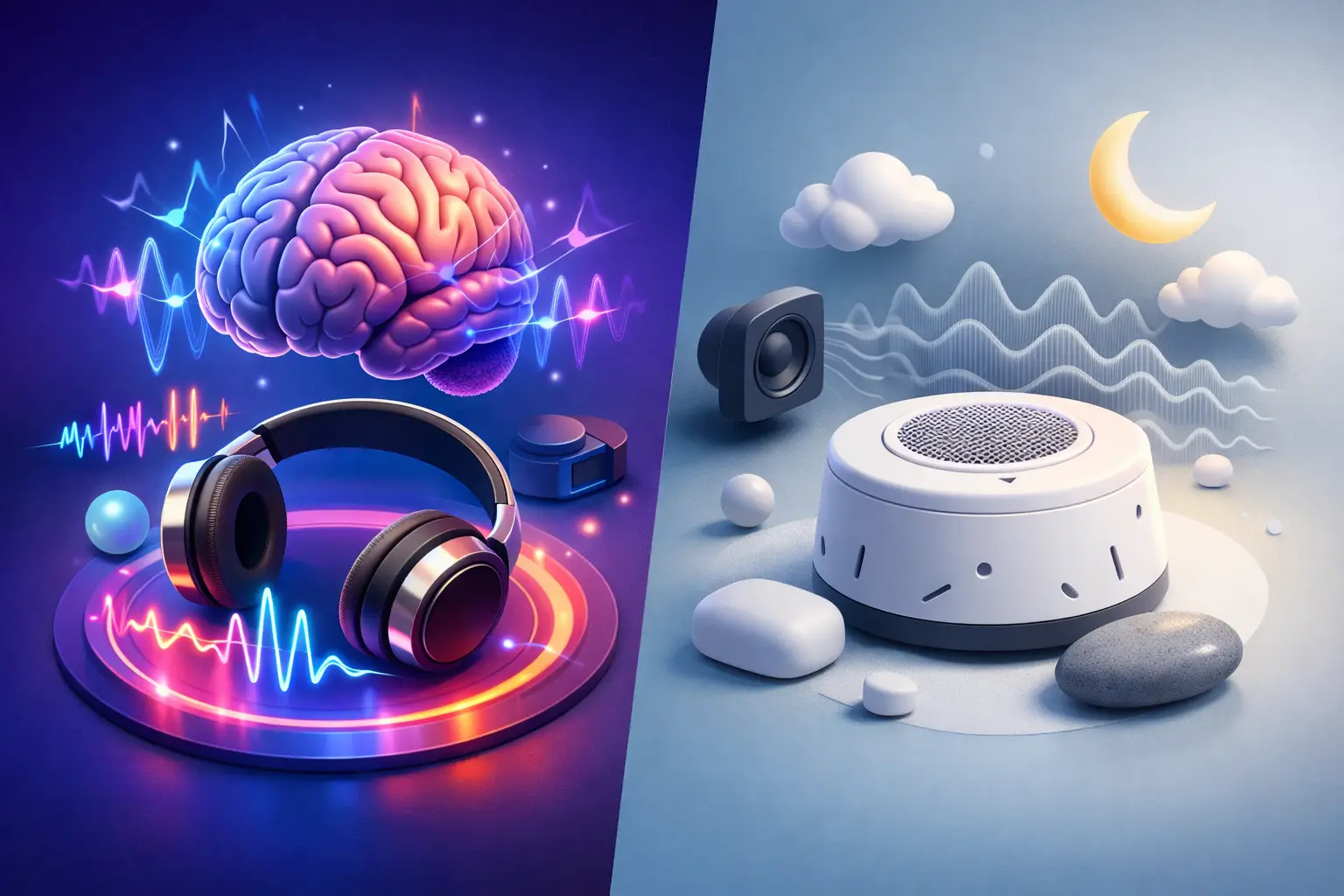
You do not need more background sound. You need the right sound for the state you want. That is the real difference in brainwave audio vs white noise. One is designed to influence your mental rhythm. The other is built to cover distractions. Both can help, but they are not solving the same problem.
If you are trying to focus harder, calm down faster, or shift out of mental static, this distinction matters. Choosing the wrong audio can leave you feeling underwhelmed, overstimulated, or simply unchanged. Choosing the right one can make your work block smoother, your wind-down quicker, and your headspace easier to manage.
Brainwave audio vs white noise: what sets them apart
White noise is a steady, consistent sound that spreads across frequencies. Think of a fan, static, or a soft hiss. Its main job is simple - mask outside noise and create a more stable sound environment. That makes it useful when barking dogs, traffic, office chatter, or household noise keep pulling your attention away.
Brainwave audio has a different goal. It is usually designed to encourage your brain toward a certain mental state by using frequency-based stimulation, often through binaural beats or similar audio patterns. Instead of just covering distractions, it aims to support focus, relaxation, meditation, or sleep by nudging your brain toward a target rhythm.
That is why brainwave audio often feels more intentional. It is not just there in the background. It is there to do something.
What white noise does well
White noise is practical. It works because the brain has fewer sudden sound changes to react to. If you are in a noisy apartment, a shared office, or a home with kids, that can be enough to improve concentration or sleep quality.
Its biggest strength is simplicity. You do not need headphones, timing, or much experimentation. Turn it on, lower the contrast between disruptive sounds, and get on with your day. For some people, that is all they need.
It can also be a strong fit for sleep if your main issue is environmental interruption. If outside sound wakes you up, white noise can create a more consistent backdrop and reduce those startle moments that break sleep.
The limitation is that white noise does not actively guide your state. If your mind is racing, your mood is off, or your focus is fragmented from internal stress rather than external noise, white noise may help a little, but it may not change the core problem.
What brainwave audio does well
Brainwave audio is built for state change. That is why people turn to it for deep work, stress relief, meditation, and emotional reset. It is less about blocking the world and more about helping your brain lock into a useful pattern.
For example, some tracks are designed to support alert concentration. Others aim for calm, introspection, or pre-sleep relaxation. That range makes brainwave audio more flexible than white noise if your goal is not just quiet, but performance or regulation.
This is where binaural beats stand out. By delivering slightly different frequencies to each ear, they create a perceived internal beat that may support a targeted mental state. Many users describe the effect as subtle but noticeable - less mental friction, better task immersion, a smoother transition into calm, or an easier time settling into a routine.
That does not mean every track works the same for every person. Response varies. Some people feel a shift quickly. Others need a few sessions and the right timing. But when the match is right, brainwave audio can feel more like a tool than a soundtrack.
Which is better for focus?
If your focus problem comes from a noisy environment, white noise can be enough. It reduces interruptions and helps your attention stop bouncing toward every random sound. For open offices and busy homes, that matters.
But if your focus problem is internal - overthinking, scattered attention, low motivation, mental fatigue - brainwave audio usually has the edge. It is designed to support cognitive state, not just acoustic control. That can make it more effective for studying, writing, planning, coding, or any task that requires sustained mental energy.
This is why high-performers often prefer targeted audio over generic ambient sound. They are not just trying to hear less. They are trying to operate better.
Which is better for relaxation and stress?
White noise can be soothing because it is predictable. There is comfort in a stable, unchanging sound, especially after a chaotic day. But its stress-relief effect is mostly indirect. It calms the environment, which may help calm you.
Brainwave audio is the stronger option when stress feels internal. If your nervous system is wound up, your thoughts are looping, or your body is tense, state-based audio can support a more deliberate downshift. That is especially useful for transitions - after work, before bed, or before meditation.
The trade-off is that brainwave audio asks for a little more intention. You may need headphones for binaural beats. You may need to choose the right track for the outcome you want. White noise is easier. Brainwave audio is more targeted.
Which is better for sleep?
This one depends on why you are not sleeping.
If sound disruption is the main issue, white noise is often the better first move. It masks external disturbances and keeps your bedroom acoustically stable.
If the issue is mental overstimulation, stress, or difficulty winding down, brainwave audio may offer more value. Sleep-focused tracks can help create a gentler descent into rest, especially when your body is tired but your brain refuses to cooperate.
Some people use both, just not at the same time. Brainwave audio during the wind-down phase, then white noise through the night. That approach makes sense because the goals are different - one helps shift state, the other helps protect it.
Brainwave audio vs white noise for productivity
For productivity, white noise is a support layer. Brainwave audio is a performance tool.
That does not mean white noise is weak. It is effective for reducing distraction and preserving consistency. But if you are trying to sharpen attention, maintain momentum, and reduce the mental drag that kills output, brainwave audio is usually the more strategic choice.
This is where a well-built library matters. Different tasks call for different states. Deep analytical work is not the same as creative flow. Emotional reset is not the same as pre-sleep decompression. A broad set of targeted tracks gives you more control than one generic sound loop ever could.
When white noise wins
White noise is the better option when you want low effort, all-day usability, and environmental masking. It is also more comfortable for people who do not want noticeable audio stimulation or who simply prefer a neutral backdrop.
It can be ideal for babies, shared bedrooms, travel, office settings, and people who get distracted by unpredictable sound. If your need is mostly practical, white noise earns its place.
When brainwave audio wins
Brainwave audio wins when your goal is mental direction. If you want sharper focus, faster calm, better emotional control, or a stronger transition into sleep or meditation, it offers more upside.
It is especially valuable for people who want audio to do more than fill silence. Professionals, students, and self-optimizers often need support that matches the moment. A focused track for work. A calming track for stress. A restorative track for reset. That is where tools like Hertzbox Pro fit naturally into a daily routine.
The smartest way to choose
Start with the problem, not the trend. If noise around you is the main issue, use white noise. If noise inside you is the problem, use brainwave audio. If both are true, use each where it fits.
There is no prize for picking one camp and forcing it to do everything. Audio works best when it matches the outcome. White noise creates cover. Brainwave audio creates direction.
If your goal is to feel less distracted, less stressed, and more in control of your state, that difference is worth paying attention to. The right sound will not just make your environment better. It can make you better inside it.