
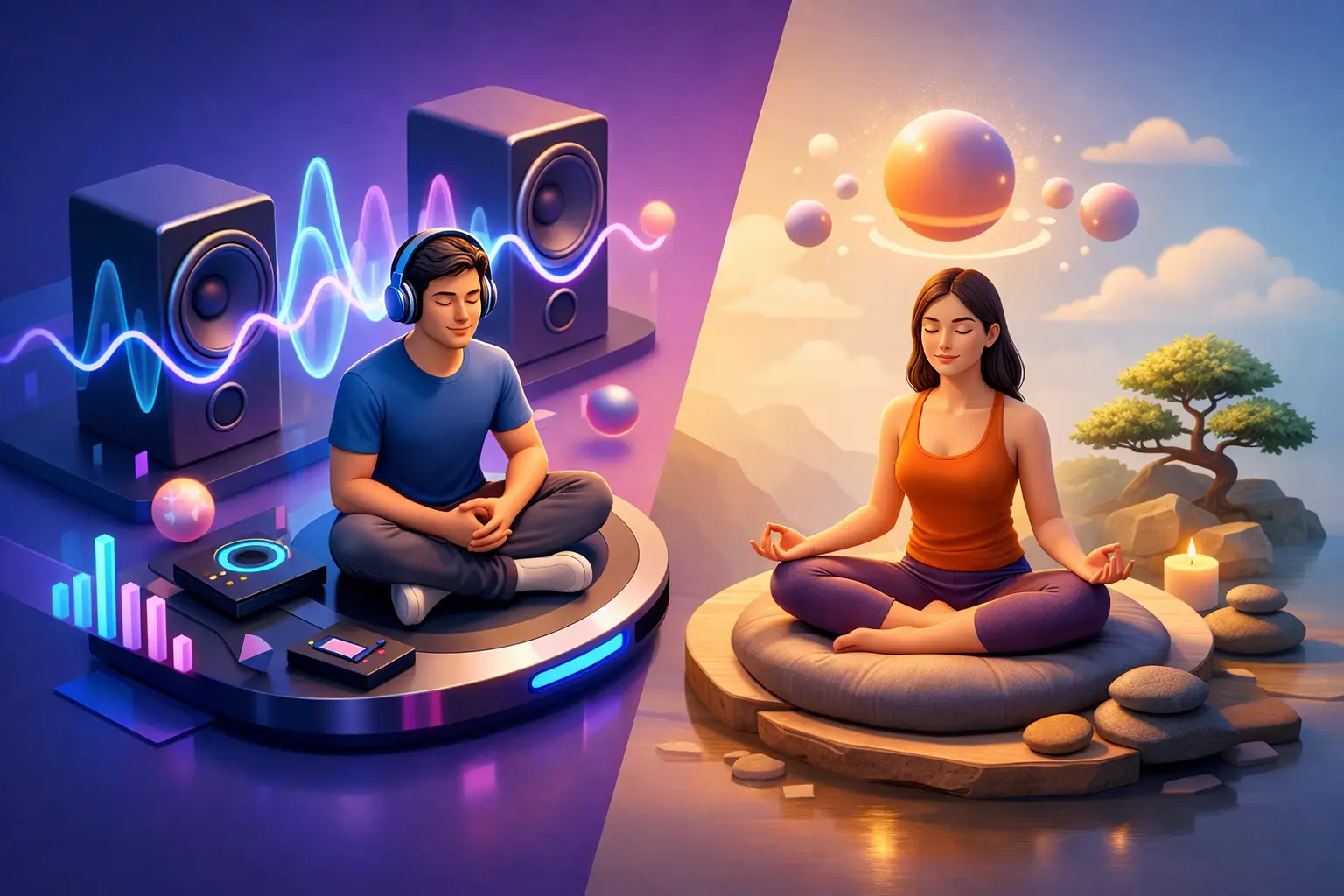
Some days, you need calm. Other days, you need your brain to lock in and perform. That is where the real question around binaural beats vs meditation starts - not in theory, but in the middle of a work sprint, a stressful afternoon, or a night when your mind will not slow down.
Both tools aim to shift your mental state. Both can help with stress, focus, and emotional balance. But they do not work the same way, and they do not ask the same thing from you. If you want a practical answer, here it is: meditation trains the mind over time, while binaural beats help guide the mind into a desired state with less effort and less friction.
That difference matters more than most people realize.
Binaural beats vs meditation: the core difference
Meditation is an internal skill. You sit, breathe, observe, redirect, and gradually build more control over attention and awareness. The longer you practice, the more that skill tends to grow.
Binaural beats are an external audio tool. They use slightly different frequencies in each ear to create a perceived beat in the brain. The goal is to encourage your brain toward a certain state, whether that is deeper relaxation, sharper concentration, or a calmer emotional baseline.
So the comparison is not really old vs new or natural vs technical. It is training vs support.
Meditation asks you to generate the state. Binaural beats help induce the state.
For busy people, that distinction is huge. If your schedule is packed and your stress is high, a tool that helps your brain settle faster can feel more realistic than trying to master a practice that takes consistency, patience, and mental discipline.
When meditation is the better choice
Meditation has real strengths, especially if your goal is long-term self-regulation. Over time, it can improve how you respond to stress, distractions, and emotional spikes. It can help you become less reactive and more intentional.
That makes meditation especially useful if you want to build mental endurance, not just get a quick reset. It is less about immediate performance and more about changing your relationship with your thoughts.
There is a trade-off, though. Meditation can be hard at the exact moment you need it most. When your brain is overstimulated, anxious, or tired, sitting in silence is not always calming. Sometimes it feels like being trapped in a room with your own mental noise.
That is why so many people say they "cannot meditate." In many cases, they are not failing. They are just trying to use a skill-based method before they have enough internal control to make it work well.
When binaural beats have the edge
Binaural beats tend to shine when you want a faster shift with less effort. You put on headphones, press play, and let the audio do part of the work. That makes them attractive for people who want support without needing to learn a whole practice first.
If your main goal is focus, this advantage becomes even clearer. A lot of meditation is designed to reduce attachment, slow down, and observe. That is valuable, but it is not always what you want before a study session, a strategy meeting, or a deep work block. In those moments, you may want activation, clarity, and sustained concentration.
That is where targeted audio can feel more precise. Instead of asking you to mentally steer yourself into a state, binaural beats can help create the conditions for that state. For someone dealing with brain fog, scattered attention, or emotional friction, that can be the difference between intending to focus and actually focusing.
For this reason, binaural beats often fit modern routines better. They are easier to stack into real life - while journaling, working, reading, stretching, or winding down before sleep.
Which one works faster?
If by "works" you mean creates a noticeable state change in the moment, binaural beats usually win.
Meditation often has a slower payoff curve. A single session may help you feel calmer, but the bigger returns come through repetition. It is a training effect. You build the ability over time.
Binaural beats are more immediate. Not everyone responds the same way, but many users feel a shift in relaxation, concentration, or mental quiet within one session. That makes them appealing for people who are outcome-driven and do not want a long runway before they feel benefits.
This does not mean binaural beats are a replacement for mental discipline. It means they are efficient. They can lower the barrier between your current state and the state you want.
That efficiency is a major reason audio-based wellness has gained traction. People are not just looking for ideals. They are looking for tools they will actually use.
Binaural beats vs meditation for focus, stress, and sleep
The better option often depends on the result you want.
For focus, binaural beats often have the advantage because they are easy to use during work or study and can support concentration without requiring you to stop everything and practice. Meditation can improve focus too, but usually through long-term training rather than instant performance support.
For stress relief, it depends on your personality and your state. If you already have some comfort with stillness, meditation can be deeply effective. If your nervous system is overloaded and silence feels frustrating, binaural beats may be the easier entry point.
For sleep, both can help. Meditation can quiet racing thoughts, while binaural beats can create a more soothing mental descent into rest. People who struggle with mental chatter often find audio easier because it gives the mind something gentle to follow.
The pattern is simple. Meditation is often stronger for capacity-building. Binaural beats are often stronger for state-shifting.
The effort factor most people ignore
A wellness tool only works if you use it.
This sounds obvious, but it is where many comparisons fall apart. Meditation is free and powerful, but it also asks for consistency, tolerance for discomfort, and a willingness to practice without immediate rewards. That works for some people. For others, it becomes one more thing they feel guilty about not doing.
Binaural beats lower that resistance. They are accessible, structured, and easy to repeat. You do not need to wonder whether you are doing it right. You do not need years of practice to get value. You just need the right track for the right goal and a few minutes of attention.
That simplicity is not a weakness. It is a performance advantage.
For people balancing work pressure, family demands, overstimulation, and the constant pull of digital life, convenience matters. The best mental wellness tool is often the one that fits your real life instead of your ideal life.
Do you have to choose between them?
No - and that is probably the smartest answer.
Binaural beats and meditation can work extremely well together. In fact, using binaural beats before or during meditation can make meditation easier, especially for beginners or anyone with a restless mind. The audio helps reduce internal noise, and that can make it easier to settle into stillness.
You can also use them for different jobs. Use binaural beats when you need focus, emotional regulation, or a faster state shift. Use meditation when you want to build awareness, resilience, and deeper self-control over time.
That combination gives you both speed and depth. One tool helps you perform better now. The other helps you become stronger over time.
For many people, that is the sweet spot.
How to decide what fits you best
Ask a more useful question than "Which is better?" Ask, "What do I need today?"
If you need immediate calm, faster focus, or help getting out of a mental spiral, binaural beats may be the better fit. If you want to train your attention, increase your self-awareness, and build a long-term practice, meditation may be worth the investment.
And if you want a realistic, high-performance approach, use both strategically. There is no prize for making wellness harder than it needs to be.
A focused audio library like Hertzbox Pro makes this easier because it gives you targeted options instead of a vague, one-size-fits-all experience. That matters when your goals are specific and your time is limited.
The real win is not choosing the more impressive method. It is choosing the one that helps you feel better, think clearer, and show up stronger when it counts. Start with the tool you will actually use, and let results lead the next step.