Your brain does not need the same setting for every task. The mental gear that helps you finish a demanding proposal is rarely the one that helps you fall asleep, process stress, or generate a fresh idea. Understanding theta waves versus beta waves gives you a clearer way to match your environment, habits, and audio routine to what your mind needs right now.
Neither state is automatically better. Beta is built for active engagement. Theta supports a quieter, more inward-facing mode. The advantage comes from recognizing the difference and using each state with intention rather than trying to force focus when your system needs recovery.
Theta Waves Versus Beta Waves: The Functional Difference
Brain waves are rhythmic patterns of electrical activity measured in the brain. They are often grouped by frequency, measured in hertz, or cycles per second. Your brain produces multiple patterns at once, and those patterns shift depending on attention, stress, fatigue, sleep, and what you are doing.
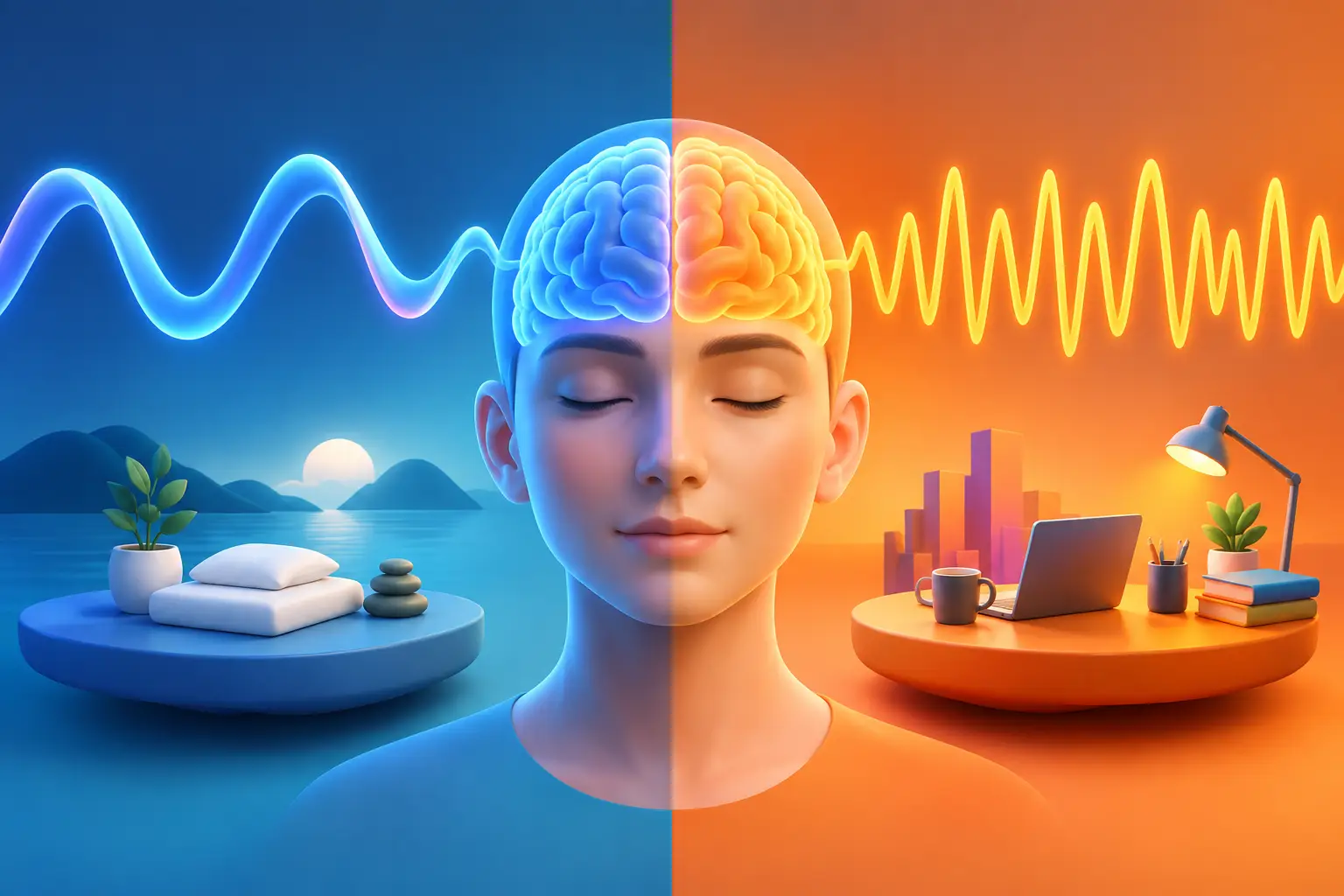
Beta waves are generally associated with alert, outward-directed thought. They commonly fall in the range of about 13 to 30 Hz. When you are reading closely, making decisions, solving a problem, participating in a meeting, or responding to a deadline, beta activity is part of the picture.
Theta waves are slower, usually around 4 to 8 Hz. They are often linked with deep relaxation, the transition into sleep, vivid imagery, meditation, memory processing, and free-flowing thought. You may encounter more theta activity during a quiet body scan, a long shower, a daydream, or the hazy edge between wakefulness and sleep.
The simplest distinction is this: beta helps you engage with the task in front of you, while theta makes more room for internal processing, rest, and associative thinking. Real life is more nuanced than a switch between two modes, but the contrast is useful.
Beta Waves: Your Active Performance State
Beta is the rhythm most people recognize as being mentally "on." It supports the kind of attention required to organize information, communicate clearly, manage details, and stay responsive when the stakes are real.
For professionals, beta-friendly moments include preparing for a presentation, reviewing financial details, handling customer communication, studying for an exam, or moving through a focused work sprint. This is not necessarily a calm state. It is a mobilized one.
That is the trade-off. Productive beta activity can help you direct attention, but high-beta activity is also often discussed in connection with mental overactivation. If your thoughts are racing, your shoulders are tight, and every notification feels urgent, more stimulation is not always the answer. The goal is not to stay intensely activated from morning until night. The goal is to access clear, usable focus without tipping into pressure and mental noise.
A beta-oriented audio session can fit well before or during structured work, especially when you need to reduce distraction and create a consistent start ritual. Keep the task specific. “I will work on this report for 30 minutes” gives active attention somewhere to go. Audio cannot replace sleep, planning, or a manageable workload, but it can help signal that it is time to begin.
When beta may be the better fit
Choose a more alert, focus-oriented approach when you need to analyze, execute, communicate, or make a decision. It can be especially useful during a midafternoon slump when you still need to perform, not unwind.
Be cautious with activating audio late at night or when you already feel wired. If your nervous system is running hot, pushing harder can make concentration worse. In that moment, restoring calm may be the faster route back to effective work.
Theta Waves: Your Reset and Insight State
Theta is less about checking boxes and more about creating mental space. It is commonly associated with the deeply relaxed territory between full alertness and sleep. That makes it a natural fit for meditation, visualization, creative reflection, and winding down.
Think about the moments when a solution appears after you stop staring at the problem. Your attention loosens. You take a walk, lie down, or let your mind wander. Theta is not a magic creativity button, but a quieter state can reduce the grip of rigid, repetitive thinking. That can make it easier to notice connections you missed while pushing through in full task mode.
Theta-focused sessions can also support a transition out of work. Many high performers finish the day physically away from their desk but mentally still inside the inbox. A deliberate downshift gives your brain a boundary. It tells your system that analysis, reaction, and output are no longer required.
For some people, theta-style audio feels ideal before bed, during journaling, breathwork, or a short recovery break. For others, it can make them too sleepy to work. That is not failure. It is useful feedback about timing.
When theta may be the better fit
Use a slower, calming approach when you want to decompress, meditate, reflect, visualize, or prepare for sleep. It may also be useful after a stressful interaction, when the mind keeps replaying what happened and you need to create distance before responding.
Theta is usually not the first choice for tasks that demand rapid calculations, careful proofreading, or active participation in a high-stakes call. Relaxation can be productive, but it is not interchangeable with alertness.
Can Binaural Beats Change Your Brain State?
Binaural beats use two slightly different tones, one played in each ear, to create the perception of a third rhythmic beat. The idea is that this auditory effect may encourage the brain toward a particular frequency range. Research into binaural beats is promising in some areas but remains mixed, with results varying by the person, frequency, session length, and outcome being measured.
That means binaural beats should be treated as a practical support tool, not a clinical treatment or a guarantee that your brain will enter one exact state on command. Your sleep, stress level, caffeine intake, mindset, and the task itself all matter.
Still, the ritual can be powerful. Headphones on. Notifications off. One intention chosen. For many people, that structure makes it easier to stop drifting and start shifting. Hertzbox Pro is designed around that simple advantage: targeted audio you can use to create a more focused, grounded, or restorative window in your day.
If you are new to binaural beats, start with a 15- to 30-minute session in a low-risk setting. Use stereo headphones, keep the volume comfortable, and notice what changes. Do you feel more settled? More ready to work? Sleepier than expected? Your response is more valuable than chasing a perfect label.
How to Choose Between Theta and Beta Audio
Start with the result you need, not the frequency name. If you need to finish a task, study actively, or move through an execution-heavy block, beta-oriented audio is often the more logical experiment. If you need to release the workday, settle your thoughts, or create room for reflection, theta-oriented audio may serve you better.
Timing matters just as much. A beta session at 9 a.m. and a theta session at 9 p.m. can reinforce a healthy rhythm: activate when it is time to perform, then downshift when it is time to recover. But your schedule may call for a different approach. A night-shift worker, a parent taking a midday reset, and a student studying before an evening exam will all need different timing.
Avoid multitasking your way through the experiment. Do not use a theta track while scrolling stressful content and expect deep calm. Do not play a focus track while jumping between five unrelated tasks and expect clean concentration. Give the session a job.
It also helps to track your experience for a week. Write down the audio type, time of day, task, and how you felt afterward. You will quickly see patterns. Maybe beta works best for early writing but feels too intense after coffee. Maybe theta helps you sleep when used 30 minutes before bed but leaves you sluggish if used during a work break. Personal calibration beats generic advice.
The Best Brain State Is the One That Fits the Moment
The real lesson in theta waves versus beta waves is not that one state wins. Performance without recovery eventually turns into burnout, while recovery without action can become avoidance. Your mind needs both gears.
Use beta when you need to show up, think clearly, and move. Use theta when you need to soften the noise, regain perspective, and let your system reset. With a little intention, audio becomes more than background sound. It becomes a cue that helps your brain recognize what comes next.