
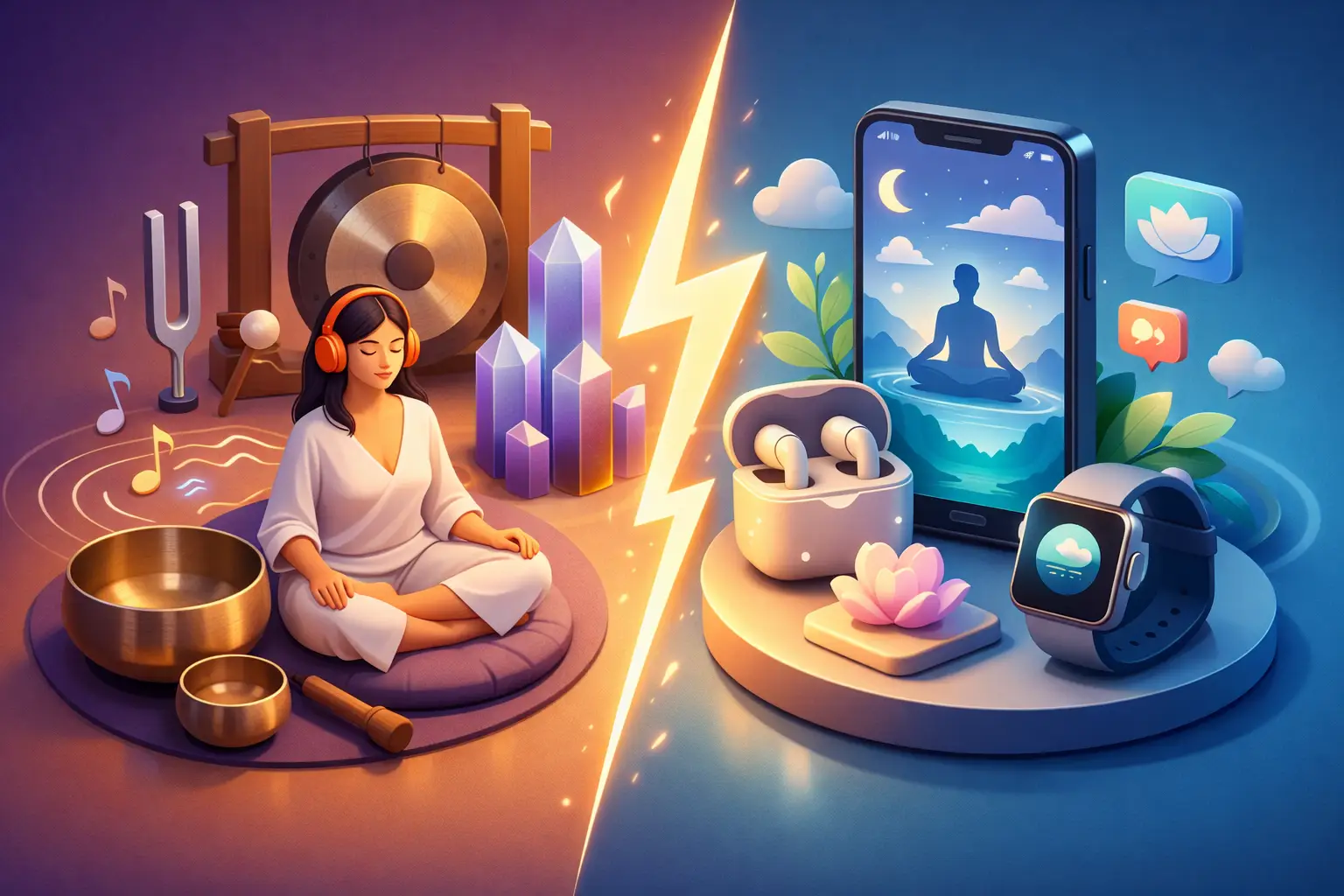
You do not need another wellness tool that sounds good in theory but disappears from your routine in three days. When people compare sound healing vs mindfulness apps, the real question is simple: what actually helps you shift your mental state fast enough to matter in real life? Start Listening
That matters if you are trying to lock in at work, calm your nervous system after a hard day, or stop mental noise from draining your energy. Both options promise relief, clarity, and better internal control. But they work differently, ask different things from you, and fit different moments.
Sound healing vs mindfulness apps: what is the difference?
Mindfulness apps usually guide you through a process. You listen to a voice, follow instructions, notice your breath, observe your thoughts, and practice staying present. The method is active, even when the goal is relaxation. You are training attention.
Sound healing tools, including binaural beats and other frequency-based audio experiences, work more like state-setting environments. Instead of teaching you to think differently in the moment, they aim to create conditions that support a different mental or emotional state. You press play, put on headphones if needed, and let the audio do more of the heavy lifting.
That difference is bigger than it sounds. A mindfulness app often asks for participation, patience, and some willingness to learn a skill. Sound healing is usually easier to drop into an existing routine because it feels less like practice and more like activation.
For a busy professional or student, that can be the deciding factor. If your brain is overloaded, the last thing you may want is another guided exercise that requires effort before you feel results.
When mindfulness apps win
Mindfulness apps are useful when your goal is long-term mental discipline. If you want to become less reactive, more aware of your thought patterns, or better at sitting with discomfort, guided mindfulness can be powerful. Over time, it can help build emotional regulation from the inside out.
They also make sense for beginners who want structure. A good app can walk you through meditation, sleep stories, breathing sessions, and stress reduction techniques in a way that feels approachable. If you have never built any kind of awareness practice, that guidance can remove friction.
There is also a strong habit-building advantage. Many mindfulness platforms are designed around streaks, reminders, and short daily sessions. That kind of structure helps people stay consistent.
But there is a trade-off. Some users do not want a lesson every time they need relief. If you are anxious, mentally fatigued, or trying to focus before a deadline, being talked through your own mind can feel helpful one day and irritating the next. Mindfulness is valuable, but it is still a skill. Skills take energy to build.
When sound healing wins
Sound healing tends to shine when the goal is immediate state change. You want to focus. You want to settle. You want your mind to stop pulling in five directions at once. In those moments, audio designed for specific mental outcomes can feel more direct.
That is especially true with binaural beats. Because they are built around targeted listening experiences, they appeal to people who want a faster on-ramp to concentration, calm, or reset. You are not being asked to interpret your thoughts. You are creating a better audio environment for your brain to work inside.
This makes sound healing highly practical for modern schedules. You can use it while working, journaling, recovering after stress, or preparing for sleep. It fits around life instead of asking life to pause.
There is also less resistance for people who say they are bad at meditation. Many people are not bad at it. They just do not want another task that feels performative. Sound healing removes some of that pressure. You do not need to clear your mind. You need to press play and give the session a real chance.
Sound healing vs mindfulness apps for focus
If focus is the priority, sound healing often has the edge.
Most mindfulness apps are not built primarily for deep work. They are often strongest in stress relief, sleep, and general meditation. Some offer focus timers or concentration sessions, but the experience still tends to center around guided attention rather than sustained cognitive performance.
Sound-based tools can be more efficient for work blocks because they support the task without demanding center stage. That matters when you are writing, studying, designing, or trying to stay mentally sharp through repetitive work. You do not always need coaching. Sometimes you need cleaner mental bandwidth.
This is where specialized audio libraries stand apart from general wellness apps. A broad platform tries to be everything at once. A focused binaural beat system is designed around specific states and outcomes. That kind of specialization is useful when your goal is not vague relaxation but measurable mental performance.
For stress relief, it depends on your personality
If you calm down by understanding what you feel, mindfulness apps may be a better fit. Guided practices can help you slow down, name what is happening, and interrupt stress spirals before they build momentum. There is comfort in being led.
If you calm down by reducing sensory and mental overload, sound healing may work better. The right audio can create enough space for your system to downshift without asking you to analyze anything.
This is one of the biggest it-depends decisions in wellness tech. Some people want guidance. Others want relief without more language. If your day is already full of meetings, notifications, and constant verbal input, a nonverbal tool can feel dramatically more restorative.
Ease of use matters more than people admit
The best tool is not the one with the most features. It is the one you will actually use when you need it.
Mindfulness apps can lose people because they are content-heavy. Dozens of categories, teachers, themes, and programs sound helpful until decision fatigue kicks in. You open the app to relax and end up scrolling.
Sound healing is often simpler by design. Choose the outcome, start the track, and let the session run. That simplicity is not a small advantage. It is a compliance advantage. The easier a tool is to use, the more likely it becomes part of your routine.
For users who want mental optimization without adding complexity, audio-first tools fit better. That is a big reason specialized platforms like Hertzbox Pro appeal to people who want focused, ready-to-use binaural beats instead of an all-purpose mindfulness library.
What each option does not do well
Mindfulness apps are not always ideal for high-pressure moments that call for immediate performance. If your attention is fractured and you need to produce, a calm voice telling you to notice your breath may not get you where you need to go fast enough.
Sound healing is not a full replacement for self-awareness training. If you want to build a deeper relationship with your thoughts, reactions, and emotional patterns, audio alone may not cover that ground. It can support the state, but it may not teach the reflective skill.
That is why this is not really a battle with one winner. It is a question of fit. Are you trying to train attention over time, or shift your state right now?
The smarter choice for most people
For many people, the strongest answer is not either-or. It is knowing which tool matches the moment.
Use mindfulness apps when you want intentional reflection, guided breathing, or a structured practice that develops self-awareness. Use sound healing when you want faster access to focus, emotional reset, or a calmer internal baseline without extra effort.
If you only want one tool, choose based on your actual behavior, not your ideal self. If you know you are unlikely to sit through guided sessions consistently, a sound-based system may deliver more value because it meets you where you are. If you enjoy instruction and want to build mental discipline over time, mindfulness may be worth the investment.
A lot of wellness products fail because they ask too much before they give anything back. The better tools create momentum early. They help you feel a shift, then make it easy to repeat. That is what turns a nice idea into a daily advantage.
Your mind does not need more noise. It needs the right input at the right time. Choose the tool that makes clarity, calm, and focus easier to reach, especially on the days when you need them most.