
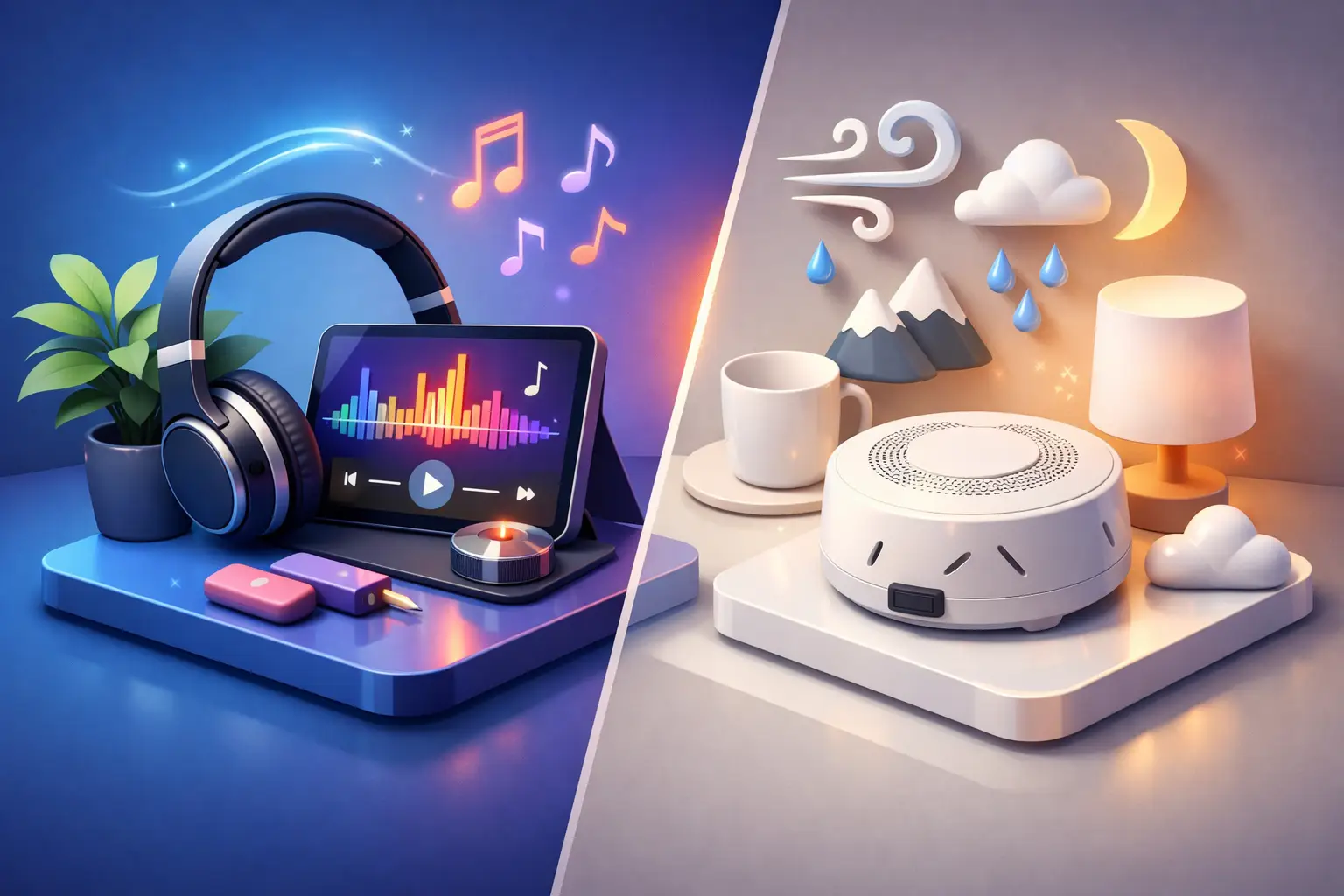
Your environment is either helping your brain lock in or quietly pulling it apart. A colleague’s conversation, traffic outside, a looping thought about your inbox - even small distractions can break momentum. In the focus music vs white noise debate, the best answer is not one universal sound. It is the sound that gives your brain less to fight and more room to perform.
For deep work, studying, creative output, or a reset between demanding tasks, audio can become a powerful cue: this is the moment to concentrate. The key is choosing it with intention rather than pressing play on whatever happens to be available.
Focus Music vs White Noise: The Core Difference
White noise is a steady, broadband sound that spreads across audible frequencies. Think of a fan, rainfall-like static, or a soft electronic hiss. Its main job is not to motivate you. It is to mask unpredictable sounds that compete for your attention.
Focus music works differently. It creates an atmosphere, rhythm, and emotional tone. It may include ambient textures, soft piano, electronic beats, nature sounds, or a carefully designed frequency track. The right music can make a task feel more engaging, regulate your energy, and establish a repeatable work ritual.
That difference matters. White noise reduces contrast in the environment. Focus music gives the mind something controlled and supportive to follow. One can create a blanker canvas; the other can create a mental state.
Neither is automatically better. If external noise is your biggest enemy, white noise may be the faster solution. If you are mentally scattered, low-energy, or struggling to enter a productive rhythm, the right focus audio may offer more value.
When White Noise Helps You Work
White noise is especially useful when your workspace is full of interruptions you cannot control. Open offices, apartment buildings, coffee shops, shared homes, and travel days all create sudden sounds that force your attention to reorient. A consistent sound layer can make those interruptions less noticeable.
It also works well for tasks that need language processing. If you are writing, reading dense material, answering emails, or reviewing data, lyrics can become another stream of words your brain has to process. White noise gives you sound without a storyline.
The trade-off is that white noise can feel emotionally flat. Some people find it calming; others find it sterile or fatiguing after an hour. If the sound is too bright, too loud, or too hiss-heavy, it can become the distraction it was supposed to remove.
Try it when you need to block the world out, not necessarily when you need a major energy shift. Keep the volume low enough that it blends into the background. If you are actively listening to it, it is probably too loud.
White Noise Is Not the Only Noise Color
Many people say “white noise” when they really mean any steady background sound. But the character of the sound can change your experience. Pink noise is generally deeper and softer, while brown noise tends to emphasize lower frequencies and can feel fuller or more grounding.
If white noise feels sharp, do not assume noise-based audio is not for you. Test a lower, warmer sound profile. The practical goal is simple: reduce surprise in your sound environment without creating new mental friction.
When Focus Music Has the Edge
Focus music earns its place when concentration is not just about blocking sound. Sometimes the problem is internal: racing thoughts, low motivation, stress, or the sluggish transition from one task to the next.
Instrumental and ambient music can give the brain a predictable structure without demanding much attention. A gentle pulse may make repetitive work feel easier to sustain. Spacious, lyric-free tracks can help create separation between your work session and everything else competing for your mind.
This is where personal preference matters more than people expect. One person may enter flow with minimalist electronic music. Another may find that same track overstimulating and work better with slow ambient tones. There is no prize for choosing the most popular productivity playlist. Choose the audio that makes you forget it is playing while making it easier to keep going.
Avoid songs you know too well when the task is demanding. Familiar favorites can trigger memories, anticipation, and the urge to sing along. They may be perfect for cleaning, workouts, or routine admin, but less effective for analytical work or difficult writing.
For many high-focus tasks, the strongest starting point is music with no lyrics, limited changes in intensity, and a stable tempo. Think support, not spectacle.
Where Binaural Beats Fit In
Binaural beats are designed for a different purpose than ordinary music or masking noise. They use two slightly different tones, one delivered to each ear through headphones. Your brain perceives the difference between them as a rhythmic pulse.
People often use binaural beat tracks as part of a focused, calming, or reflective routine because the format gives attention a clear auditory anchor. The experience can feel less like listening to a song and more like setting a mental workspace.
Research on binaural beats is still developing, and individual results vary. They are not a substitute for sleep, mental health care, or the fundamentals of good work habits. But as a non-invasive audio tool, they can be worth testing when you want to create a more deliberate transition into focus or calm.
Hertzbox Pro is built around this practical use case: targeted binaural beat audio that helps you choose a sound environment aligned with the state you want to support. Use headphones, give a track enough time to settle in, and judge it by your real output and how you feel afterward - not by hype.
Match the Sound to the Task
The most effective audio routine changes with the kind of work in front of you. For reading, writing, coding, or studying, start with low-distraction sound: white noise, ambient audio, or lyric-free music. For repetitive tasks, organization, or routine admin, you may benefit from a little more rhythm and energy.
Creative work is more personal. Some people need quiet to hear their own ideas. Others need a gentle musical bed to move past perfectionism and start producing. If you are stuck, switch formats rather than forcing the same sound for another hour.
Use silence strategically, too. Silence is often best for high-stakes thinking, complex decisions, or any moment when sound starts to feel like another demand. Audio is a tool, not a requirement. The goal is better attention, not constant stimulation.
Build a 15-Minute Test Instead of Guessing
Do not decide based on one distracted afternoon. Test one sound type at a time during comparable work blocks. Spend 15 minutes with white or brown noise, then try 15 minutes with ambient focus music on another day. Track three signals: how quickly you start, how often you reach for your phone, and how much meaningful work is complete at the end.
Keep the volume consistent. Change only one variable at a time. If you test a new sound while hungry, exhausted, and surrounded by interruptions, you are measuring your whole day, not the audio.
After several sessions, patterns become clear. You may find that white noise is your open-office shield, ambient music is your afternoon reset, and binaural beats are your pre-work ritual. That is a smarter system than searching for one perfect sound for every situation.
Use Audio as a Focus Trigger
The biggest benefit of a consistent sound routine may be conditioning. When you use the same type of audio at the start of a work block, your brain begins to associate that cue with one job: pay attention.
Make the ritual simple. Put on headphones, choose your track, set a realistic work window, and place your phone out of reach. Do not spend 20 minutes hunting for the perfect sound. The audio should reduce decision-making, not become another form of procrastination.
If a track makes you tense, restless, sleepy, or more likely to multitask, move on. Your best focus sound is not the one with the boldest promise. It is the one that helps you begin cleanly, stay present longer, and finish with more mental energy than you expected.
Start with the problem you want to solve. If the room is too loud, use noise. If your mind is too loud, try intentional focus audio. Then let your actual work tell you what belongs in your routine.