
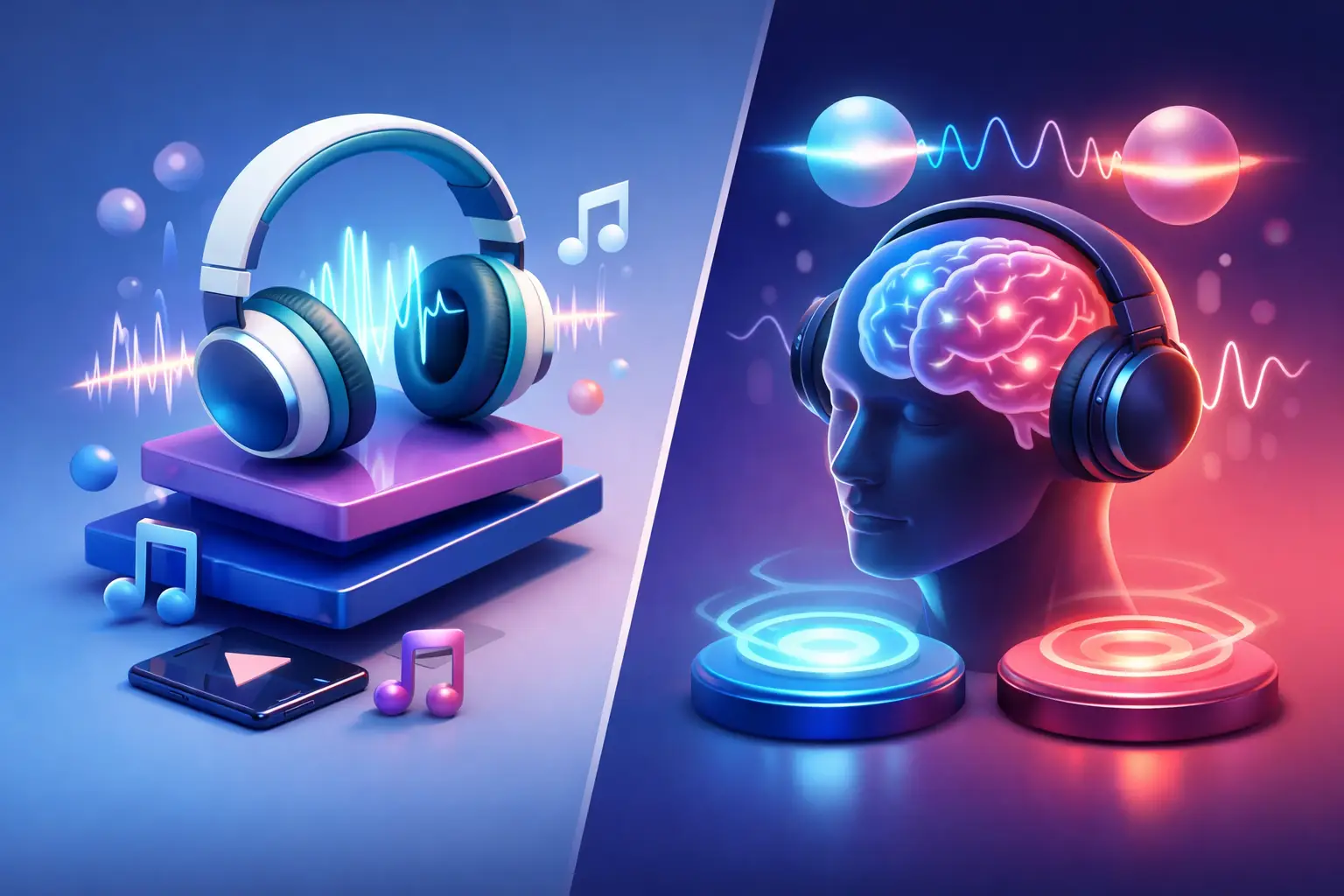
You put on headphones to get more done, not to run an audio experiment that wastes half your work block. That is exactly why the question of focus music vs binaural beats matters. Both can support concentration, but they do it in very different ways, and choosing the wrong one can leave you feeling distracted, overstimulated, or mentally flat. Start Listening
If your goal is better output, cleaner attention, and less internal noise, it helps to know what each tool is actually designed to do. Focus music usually works by shaping your environment. Binaural beats aim to shape your mental state. That difference is where the real decision starts.
Focus music vs binaural beats: what changes in your brain and behavior?
Focus music is the more familiar option. It includes instrumental tracks, ambient soundscapes, lo-fi beats, classical music, cinematic textures, and other audio designed to create a productive atmosphere. Its main job is simple: cover distractions, stabilize your mood, and make work feel easier to enter and sustain.
That can be powerful. If your workspace is noisy or your mind is scattered by every conversation, notification, or passing sound, music creates a buffer. It gives your attention something predictable to sit inside. For many people, that alone improves focus.
Binaural beats work differently. They are not primarily about entertainment or atmosphere. They use two slightly different tones, one in each ear, to create a perceived third frequency in the brain. The idea is that this auditory input can encourage the brain toward certain states linked to focus, relaxation, or mental clarity.
In practical terms, binaural beats are less about making your environment feel better and more about helping your mind lock into a more useful mode. That is why people often reach for them when regular music is not enough. They are a performance tool, not just background sound.
When focus music works best
Focus music tends to shine when your biggest problem is external friction. Maybe your office is loud. Maybe silence feels tense. Maybe your brain needs a gentle rhythm to settle into repetitive work. In those cases, music can make concentration feel more natural.
It is especially useful for tasks that benefit from momentum. Inbox clearing, light admin work, design flow, coding sprints, reading familiar material, and routine study sessions often pair well with steady instrumental audio. The right track can reduce boredom and help you stay in motion.
But there is a trade-off. Music has emotional content, structure, and movement. Even instrumental tracks can pull your attention around if they are too dramatic, too catchy, or too familiar. Lyrics are an obvious issue, but they are not the only one. A beat drop, a melody you love, or a sudden change in intensity can quietly compete with your task.
That is why focus music is not always ideal for deep cognition. If you are writing, solving complex problems, learning new material, or doing work that depends on verbal precision, music can become part of the distraction instead of the solution.
When binaural beats have the advantage
Binaural beats tend to be more useful when the problem is internal friction. Maybe your mind is racing. Maybe you feel mentally foggy. Maybe you sit down to work, but your brain never fully arrives. In those moments, environment alone is not the issue. State is.
That is where binaural beats stand out. They are designed to support the kind of mental shift that helps you concentrate with less strain. Instead of filling space with texture and mood, they give your brain a more targeted auditory signal.
For many people, this makes them especially effective for deep work, study, meditation before work, and mentally demanding tasks that require steady cognitive control. They can also help if traditional music makes you too emotionally engaged or too passive.
There is a trade-off here too. Binaural beats usually require stereo headphones to work properly, and not everyone responds the same way. Some people feel the effect quickly. Others notice a subtle change only after consistent use. They also tend to feel more functional than musical, which means they may not appeal to someone who wants audio that is enjoyable first and strategic second.
Focus music vs binaural beats for different kinds of work
The fastest way to choose is to match the audio to the task.
If you are doing shallow work, repetitive work, or creative work that benefits from emotional energy, focus music often makes sense. It can keep you engaged, reduce environmental distraction, and make the session feel less effortful.
If you are doing deep work, high-focus study, analytical tasks, or anything that falls apart when your attention drifts, binaural beats may be the stronger option. They are built for mental state support, not just background ambiance.
There is also a middle ground. Some people use focus music to start a session, then switch to binaural beats when they need to narrow in. Others use binaural beats for a 20-minute mental reset before working in silence. The point is not to force one tool into every situation. The point is to use the one that solves the problem in front of you.
Why some people think music helps when it actually hurts
A lot of people say they focus better with music, but what they often mean is that music makes working feel better. That is not the same thing.
Feeling stimulated, motivated, or emotionally lifted can absolutely help you begin. But if the audio keeps tugging at your attention, your output may suffer even while your experience improves. This is especially common with familiar playlists, songs with lyrics, and tracks tied to strong memories.
Binaural beats usually avoid that problem because they are not asking for your attention in the same way. They are more neutral. Less entertainment, more cognitive support.
That difference matters if your goal is measurable performance rather than just a more pleasant work session.
How to test focus music vs binaural beats without overthinking it
You do not need a two-week biohacking protocol to figure this out. Test each one against the same kind of task.
Use focus music for a 45-minute work block and notice three things: how fast you started, how often your attention drifted, and how mentally tired you felt at the end. On another day, use binaural beats for the same type of work and track the same markers.
Be honest about the result. The better tool is not the one that feels trendy or impressive. It is the one that gives you cleaner attention and better output.
A few details matter. Keep volume moderate. Avoid switching tracks constantly. Give any new audio method at least a few sessions before judging it. And if you are testing binaural beats, wear stereo headphones. Without them, you are not really testing the method as intended.
The better choice depends on what you need right now
This is not a battle where one side wins for everyone. Focus music and binaural beats solve different problems.
Choose focus music when you want energy, atmosphere, and protection from outside distraction. Choose binaural beats when you want a more intentional shift in concentration, calm, or mental clarity. If your challenge is environmental, music may be enough. If your challenge is neurological noise, stress, or unstable focus, binaural beats are often the more precise tool.
That precision is the reason so many performance-minded users move beyond playlists and start using specialized audio. A platform like Hertzbox Pro is built for that kind of user - someone who does not just want sound in the background, but audio designed to support a better state on demand.
The smartest move is not choosing the more popular option. It is choosing the one that removes the biggest barrier between you and your best work. When your audio matches your mental need, focus stops feeling forced and starts feeling available.