
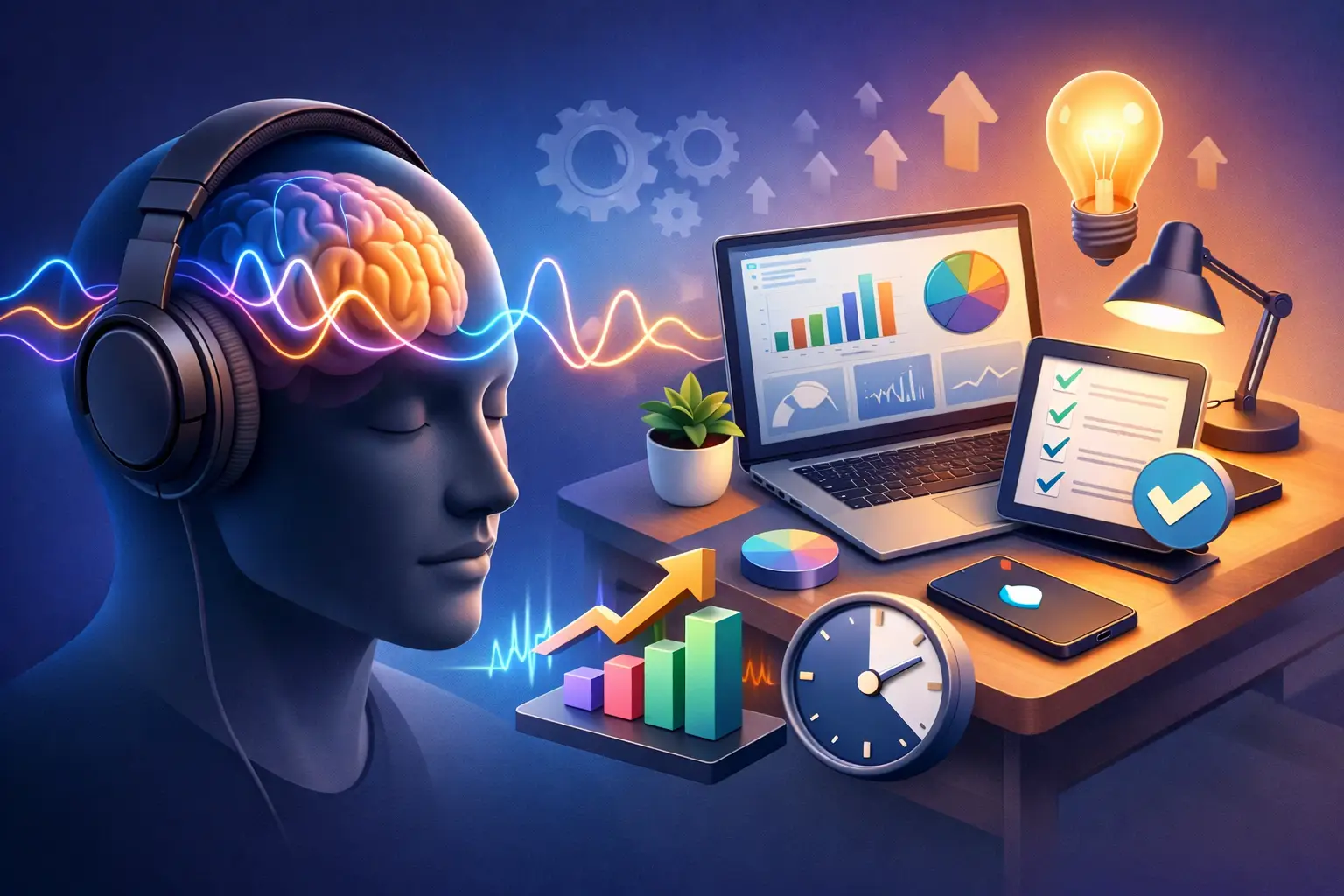
At 2:17 p.m., the workday usually breaks. Attention slips, tabs multiply, and even simple tasks start feeling heavier than they should. This brainwave audio productivity case study looks at what happens when audio is used on purpose - not as background noise, but as a tool to shape focus, reduce friction, and help more work get done with less mental drag. Start Listening
The promise behind brainwave audio is straightforward. Instead of relying on willpower alone, you use sound to support the state you want: deeper concentration, calmer thinking, or a cleaner transition into demanding work. For people who want better output without adding another complicated system, that idea is attractive for a reason.
But attraction is not proof. The real question is whether brainwave audio changes productivity in a measurable way, or whether it simply feels productive. Those are not the same thing.
The setup behind this brainwave audio productivity case study
For a useful test, productivity has to mean more than "I felt focused." In this case study, we looked at a simple but realistic scenario: one knowledge worker doing cognitively demanding work across a two-week period. The subject alternated between work sessions with brainwave audio and work sessions without it, while keeping the task type, time block, and environment as consistent as possible.
The work itself included writing, planning, spreadsheet review, and email processing. Those tasks were chosen because they reflect a normal modern workload: some deep work, some decision-making, and some lower-value admin that still has to get done.
The audio sessions used binaural beat-based tracks designed for focus. Each session lasted 45 minutes, followed by a short break. On non-audio days, the same work blocks were completed in silence or with ordinary ambient room noise. No caffeine changes, no new apps, and no productivity hacks were introduced during the test window. That matters, because it keeps the signal cleaner.
The metrics tracked were practical: number of completed task blocks, self-rated focus quality, number of attention breaks, and end-of-day mental fatigue. This is not a clinical trial. It is a performance-oriented observation designed to answer a simple question: does audio create a better work state often enough to matter?
What changed when brainwave audio was added
The first noticeable shift was startup speed. On audio sessions, the subject got into task mode faster. There was less hesitation, less tab-switching in the first ten minutes, and fewer false starts. That matters more than people think. A lot of lost productivity is not from inability. It is from the gap between sitting down and actually locking in.
Completed task blocks also improved. Across the test period, audio-assisted sessions produced a modest but consistent lift in output. The subject finished more 45-minute work blocks as planned and abandoned fewer midway through. The gain was not dramatic enough to sound magical, but it was meaningful enough to change the feel of the workday.
Focus quality improved even more than raw output. The subject reported that concentration felt less strained during audio sessions. Instead of fighting distraction every few minutes, attention stayed narrower and more stable. That did not mean perfect flow. It meant less resistance.
Mental fatigue showed the most interesting result. After deep work with brainwave audio, the subject often felt tired in a cleaner way - more like energy had been spent on the task itself, and less on battling internal noise. On non-audio days, fatigue was more scattered. The same amount of effort produced less satisfying output, which made the day feel heavier.
The trade-offs this case study exposed
A strong brainwave audio productivity case study should not pretend the tool works the same for every task. It does not.
For writing, planning, and strategic thinking, the audio performed well. These are tasks where sustained attention matters and interruptions are expensive. The sound created a stronger work container, which made it easier to hold a problem in mind long enough to make progress.
For email and quick admin, the effect was smaller. In some sessions, the audio even felt unnecessary. If a task is already simple and low-friction, adding a focus track may not move the needle much. Brainwave audio tends to show its value when the task is mentally demanding enough to trigger distraction.
There was also a timing effect. Audio helped most when used at the start of a planned work block, especially during known low-energy windows like early afternoon. It helped less when the subject was already overstimulated, anxious, or bouncing between urgent tasks. In those moments, the issue was not just focus. It was state overload.
This is where product selection matters. Not every track should be used for every mental goal. A person trying to power through a strategic work sprint needs a different auditory experience than someone trying to settle a stressed nervous system before bed. Using the wrong sound at the wrong time can flatten the benefit.
Why the results make sense
Most productivity problems are not pure discipline problems. They are state management problems.
When your brain is agitated, under-stimulated, or fragmented, the same task feels harder than it should. That is why some people can work for an hour with momentum on one day and barely hold attention for ten minutes on another. The task did not change. The internal state did.
Brainwave audio is compelling because it addresses the state layer directly. Instead of demanding more effort from a distracted mind, it aims to support a better operating condition. That is the real productivity angle. Not hype. Not instant genius. Better conditions for useful work.
For high-performers, this is a practical shift. You do not need every work session to become a peak flow experience. You need fewer wasted starts, fewer attention leaks, and fewer afternoons lost to invisible mental drag. If audio helps create that consistently, it earns its place.
What this means for people who want sharper workdays
If you are considering brainwave audio for productivity, the smartest move is to treat it like a performance tool, not entertainment. Put it around a specific block of work. Match it to a clear objective. Then measure what happens.
Start with one task category that matters. Deep writing is a good example. So is studying, analysis, or focused creation. Use the same audio for several sessions instead of changing tracks constantly. You want to test whether your brain learns to associate that sound with a work state.
Keep expectations tight. The best outcome is usually not a dramatic surge in genius. It is smoother entry, steadier focus, and lower perceived effort during demanding work. Those gains stack fast over a week.
It also helps to choose a structured audio library instead of random tracks. A focused catalog gives you more control over the result you want, whether that is concentration, calm, or recovery after a hard cognitive push. Hertzbox Pro is built around that kind of targeted use, which is why the format fits people who want state-specific audio instead of generic background sound.
The real takeaway from this case study
This case study does not prove that brainwave audio will transform every user overnight. It does show something more credible: when used with intention, it can reduce the friction around focused work and make productive states easier to access.
That is enough to matter.
A better workday is often built from small advantages that repeat. Getting into focus ten minutes faster, finishing one more meaningful block, and ending the day less mentally scrambled can change your output in ways that are easy to feel and hard to ignore.
If your biggest productivity problem is not lack of ambition but lack of mental consistency, brainwave audio is worth testing with discipline. Not because sound does the work for you, but because the right sound may help your brain stop working against you.
The most useful tools are the ones that fit real life. If audio can help you think cleaner, work longer without strain, and protect your attention when the day starts pulling it apart, that is not a gimmick. That is leverage.