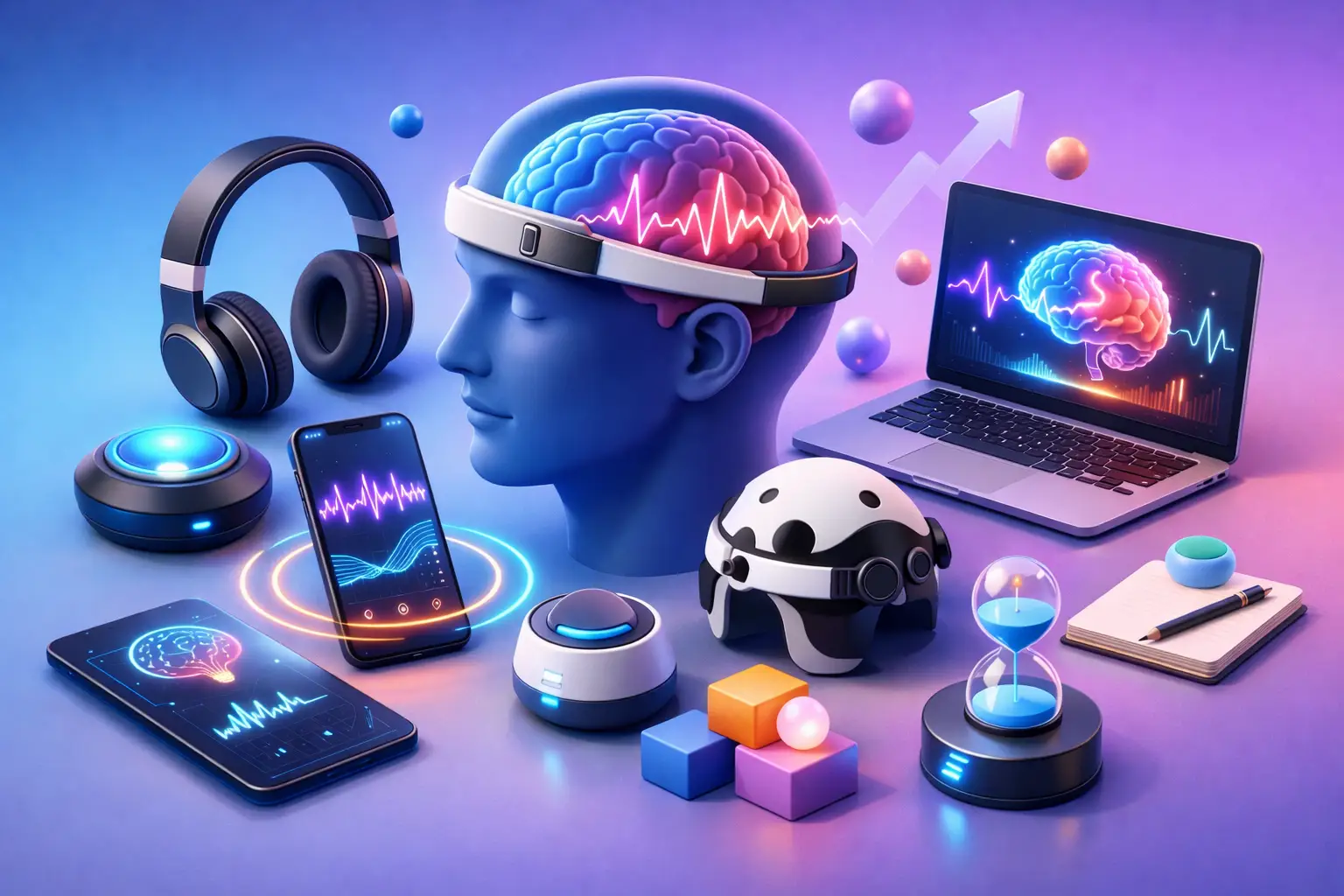
A distracted mind does not need more pressure. It needs a better signal. Finding the best brainwave tools for productivity is less about chasing a miracle frequency and more about choosing audio and feedback tools that help you enter a useful work state faster - then protecting that state long enough to do meaningful work.
For professionals, students, founders, and anyone carrying a crowded mental load, the right tool can reduce the friction between sitting down and getting started. The wrong tool can become another tab, another subscription, or another reason to avoid the task. Here is how the leading options compare, what they do well, and where they fit in a real productivity routine.
1. Binaural beats for sustained focus
Binaural beats are one of the most accessible brainwave-based tools because they require very little setup: stereo headphones and a track designed for the state you want to support. Each ear receives a slightly different tone, creating the perception of a third rhythmic beat. Many people use focus-oriented tracks during reading, writing, coding, studying, and other work that rewards steady attention.
Their biggest advantage is simplicity. You can press play, put on headphones, and create a clear transition from scattered to task-ready. A well-organized library gives you options for different moments: settling in before a hard project, holding attention through repetitive work, or decompressing after an intense block.
The trade-off is personal response. Some listeners find tonal tracks deeply settling; others prefer more musical textures or silence. Research on binaural beats is still mixed, so treat them as a practical focus aid rather than a guaranteed cognitive upgrade. Test them against a specific task and notice whether you start faster, switch less, and feel less mentally drained afterward.
2. Isochronic tones for a more pronounced rhythm
Isochronic tones use a single sound that turns on and off at a regular pace. Unlike binaural beats, they do not rely on a different tone in each ear, so headphones are not always required. The pulsing effect is more obvious, which can be useful for people who want a stronger auditory anchor while they work.
This is a good option for short, focused work sprints, especially if you tend to drift when the environment is too quiet. The pulse gives the mind something consistent to return to without demanding the attention that lyrics or a podcast would.
That same quality can be a downside. Some people experience isochronic tones as too sharp or distracting during creative work. Keep the volume low enough that it sits behind your thinking. If you become fixated on the pulse, it is not serving the assignment.
3. Ambient focus soundscapes
Rain, low drones, nature recordings, cafe ambience, and cinematic environmental soundscapes are not always marketed as brainwave tools, but they can be powerful state-management tools. Their job is often simple: cover unpredictable background noise and give your brain a stable sonic environment.
Ambient soundscapes are especially useful when you share a home, work in a noisy office, or struggle with the silence that makes every notification feel louder. They are also a strong choice for creative tasks where a clinical tone track feels too rigid.
The key is to avoid soundscapes that constantly change. Sudden thunder, birdsong, dramatic swells, or overly detailed effects can pull attention away from the page. Choose a sound bed with low variation, then pair it with a 45- to 90-minute work block.
4. Brown noise and colored noise
Brown noise has a deeper, softer character than white noise, while pink noise sits in the middle. These sounds do not claim to target a specific brainwave pattern. Instead, they mask environmental interruptions and can make a workspace feel less jagged.
For administrative work, inbox processing, data entry, or straightforward reading, colored noise can be one of the best brainwave tools for productivity because it creates fewer demands on your attention. There is no melody to follow and no pulse to analyze. Just a consistent layer that makes outside noise less intrusive.
It is not ideal for everyone. If you have tinnitus, sound sensitivity, or headaches triggered by constant audio, use caution or choose a different option. Start at a quiet volume. Productivity audio should support your nervous system, not overpower it.
5. Instrumental music with the right level of energy
Instrumental music can increase momentum when your problem is low energy rather than distraction. The best use case is work that feels tedious, familiar, or physically slow: organizing files, building slides, cleaning up a spreadsheet, or preparing for a meeting.
Choose music without lyrics in a language you understand. Lyrics compete with verbal processing, which makes them a poor match for writing, studying, and strategic thinking. A predictable instrumental playlist is usually better than an album full of dramatic shifts.
Think of instrumental music as a motivation tool, not necessarily a deep-focus tool. If you are tackling complex reasoning or sensitive work, binaural beats, ambient audio, or silence may give you more mental space. If you need to get moving, music can provide the push.
6. Neurofeedback platforms and training devices
Neurofeedback uses sensors to measure aspects of brain activity and gives you feedback in real time. Some systems are designed for home use, while others are part of clinician-guided programs. This is the most data-driven category on this list, but it is also the most expensive and demanding.
For someone who enjoys metrics and is willing to practice consistently, neurofeedback can offer useful awareness of attention and relaxation patterns. It may feel more concrete than choosing a sound track based on mood alone.
But it is not the first tool most people need. Devices vary widely in quality, interpretation, and claims. A headset cannot replace sleep, workload boundaries, treatment for a health condition, or a workable task plan. If productivity issues are persistent, severe, or tied to anxiety, depression, or attention concerns, speak with a qualified healthcare professional rather than self-diagnosing through device data.
7. Focus timers paired with intentional audio
A timer is not a brainwave technology, yet it turns audio from background entertainment into a repeatable performance cue. This pairing is where many productivity routines become effective. Use one sound type for one kind of work, set a defined block, and stop when the timer ends.
For example, use a focus-oriented binaural beat track for 50 minutes of writing, take a 10-minute screen-free break, then return for one more block. Use brown noise for email triage. Use calming audio after work to create a boundary between output mode and recovery mode.
Hertzbox Pro fits this approach because a specialized collection lets you select audio by desired state instead of forcing every task through one generic playlist. The goal is not to listen more. The goal is to make starting, sustaining, and ending focused work more deliberate.
How to choose the right tool for your brain
Start with the task, not the technology. Deep writing and analytical work usually need low-distraction audio. Repetitive work may benefit from more energy. Stressful days may call for a calming track before you attempt focus, because a tense mind often cannot force its way into concentration.
Run a simple seven-day test. Pick one priority task each day, use the same tool for a single focused block, and record three things: how long it took to begin, how often you switched tasks, and how you felt at the end. Do not judge results by whether the audio felt impressive. Judge them by whether your work moved forward.
Also protect the basics. Hydration, sleep, movement, notifications, and task clarity will always shape productivity more than any frequency. Brainwave audio works best as an environmental cue inside a system that gives your attention somewhere clear to go.
The most useful tool is the one you will actually use when the hard project is waiting. Build a small audio menu, match each sound to a work state, and let that first press of play become your signal to begin.