
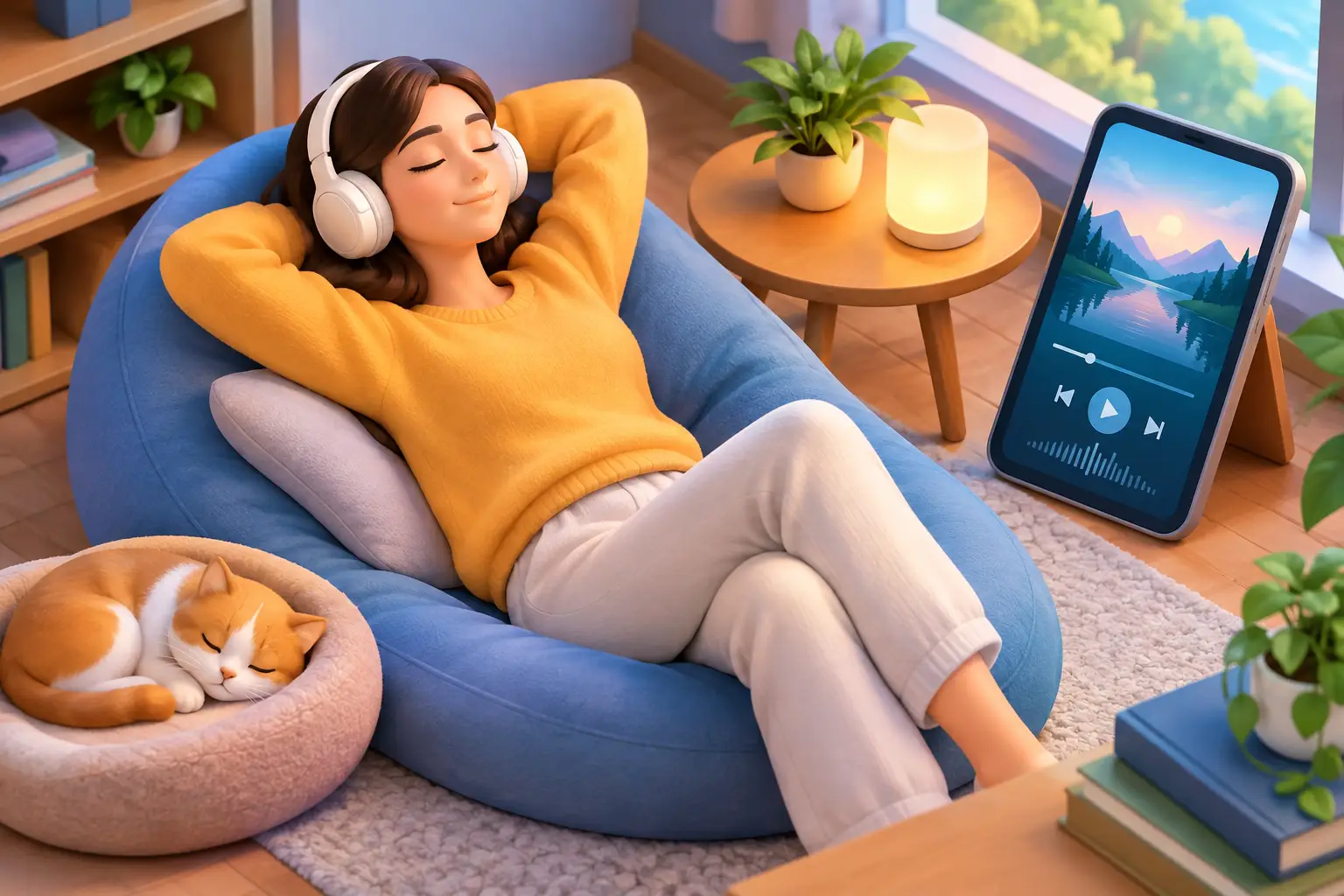
A tense body does not always need another productivity hack. Sometimes it needs a clear signal that the workday is over, the threat has passed, and it is safe to come down. The best audio tracks for relaxation do more than fill silence. They help you create a repeatable transition from mental noise to a calmer, more settled state.
The right track depends on what is driving your stress. Racing thoughts, physical tension, sensory overload, and a late-night second wind do not respond to exactly the same kind of sound. Choose audio with a purpose, use it consistently, and let it become part of the routine that tells your brain it can release the pressure.
What Makes an Audio Track Relaxing?
Relaxation audio works best when it lowers friction rather than demanding effort. You should not have to analyze a track, follow instructions, or decide what to do next. It creates a stable environment your attention can rest inside.
For some people, that means a soft rain soundscape that masks the refrigerator hum, traffic, or a noisy neighbor. For others, it is instrumental music without lyrics, which gives the mind less material to replay. Binaural beat tracks are another option for listeners who want a more intentional, headphone-based listening session built around a steady frequency difference between the ears.
No format is automatically best for everyone. If a track feels irritating, too dramatic, too repetitive, or strangely energizing, it is not the right relaxation tool for that moment. The goal is not to force a mood. The goal is to make calm easier to access.
The Best Audio Tracks for Relaxation by Need
For racing thoughts: low-distraction binaural beats
When your mind is running through unfinished tasks, conversations, and worst-case scenarios, silence can leave too much room for mental chatter. A gentle binaural beat track can give attention one simple, neutral point to settle around.
Use headphones, keep the volume low, and choose a track designed for unwinding or meditation rather than intense focus. The sound should feel like a background layer, not an event. Many listeners prefer longer sessions of 20 to 45 minutes because the first few minutes are often when the mind resists slowing down.
Research on binaural beats is still developing, and responses vary from person to person. Treat them as a practical wellness tool, not a medical treatment. If the track helps you feel less mentally scattered, that is useful feedback. If it makes you hyper-aware or uncomfortable, switch formats.
For physical tension: slow ambient music
Stress often lands in the shoulders, jaw, chest, and stomach before you consciously identify it. Slow ambient music can support a body-first reset, especially when paired with a few minutes of stretching, breathwork, or lying down with your eyes closed.
Look for sustained tones, soft piano, warm pads, or spacious instrumental arrangements with no abrupt beat drops. A predictable pace matters. Fast changes in volume or melody can pull you back into alert mode, even if the music is technically labeled relaxing.
This is an ideal choice for the gap between work and home life. Put on one track before dinner, after a commute, or immediately after closing your laptop. You are building a boundary, not just pressing play.
For overstimulation: nature soundscapes
A busy day can leave your nervous system craving fewer inputs, not more. Nature audio is effective here because it is familiar, nonverbal, and easy to ignore without feeling empty. Rain, ocean waves, wind through trees, and a steady stream can soften distracting environmental noise.
The trade-off is that highly detailed soundscapes are not restful for everyone. Bird calls, thunder, and shifting wave patterns can become something to track. Start with a simpler sound profile such as consistent rainfall or brown noise if your attention is already overloaded.
Nature tracks also work well during low-demand tasks such as tidying the kitchen, folding laundry, or taking a warm shower. That matters because relaxation does not always require stopping. It can begin while you move through ordinary life at a slower pace.
For sleep preparation: brown noise and low-frequency sound
If high-pitched sounds or sudden household noise keep pulling you out of drowsiness, brown noise may be a stronger fit than rain or white noise. Its deeper, fuller character can create a more enveloping sound bed for sleep preparation.
Keep expectations realistic. Audio cannot replace a consistent sleep schedule, medical care, or a bedroom that is too bright, hot, or noisy. But it can reduce the number of small disruptions competing for your attention while you wind down.
Use a timer if you prefer not to play audio all night. For many people, 30 to 60 minutes is enough to establish the cue: lights are low, screens are away, and the brain no longer needs to stay on call.
For emotional decompression: sound with a gentle rhythm
Some stress is not restless. It is heavy. After a difficult meeting, an argument, or a day that demanded too much emotional control, an overly minimal track can feel cold or detached. In that moment, a gentle rhythmic track may provide more support than pure ambient sound.
Choose music that feels grounded rather than sentimental or cinematic. You want a rhythm that carries you forward without pulling you into memories, lyrics, or emotional peaks. The best choice is often familiar enough to feel safe but neutral enough to avoid becoming another source of stimulation.
How to Build a Relaxation Audio Routine
The track matters, but the context matters just as much. Your brain learns through repetition. When the same sound appears alongside the same calming actions, it can become a stronger cue to downshift.
Start by assigning one track to one job. Use a binaural beat session after mentally demanding work. Use rain audio for reading before bed. Use brown noise when you need to block distractions. Avoid constantly searching for a new perfect track, because decision fatigue defeats the point.
Keep volume below the level where you feel immersed in a performance. Relaxation audio should leave room for your body to settle. If you need to turn it up to overpower everything, consider improving the environment too: dim the room, silence notifications, put the phone across the room, and reduce competing noise where possible.
Give each approach several sessions before judging it. One stressful evening is not a fair test. Try the same format for five to seven days and notice what changes: how quickly your thoughts slow down, whether your shoulders release, how often you reach for your phone, and how you feel when the track ends.
Choose Sound That Matches the Moment
There is no universal playlist that works for every nervous system. The best audio tracks for relaxation are the ones that meet your actual state instead of asking you to become someone else first. A person who feels wired may need soft, steady structure. A person who feels depleted may need warmth. A person trying to sleep may simply need fewer interruptions.
Hertzbox Pro’s targeted binaural beat library is built for this kind of intentional listening: choosing an audio state that fits the moment instead of settling for random background noise. The more precise your selection, the less effort it takes to shift gears.
Tonight, do not wait until you are completely burned out to reach for calm. Pick one track, create ten protected minutes around it, and let that small ritual become proof that your attention and recovery deserve a place on the schedule.