
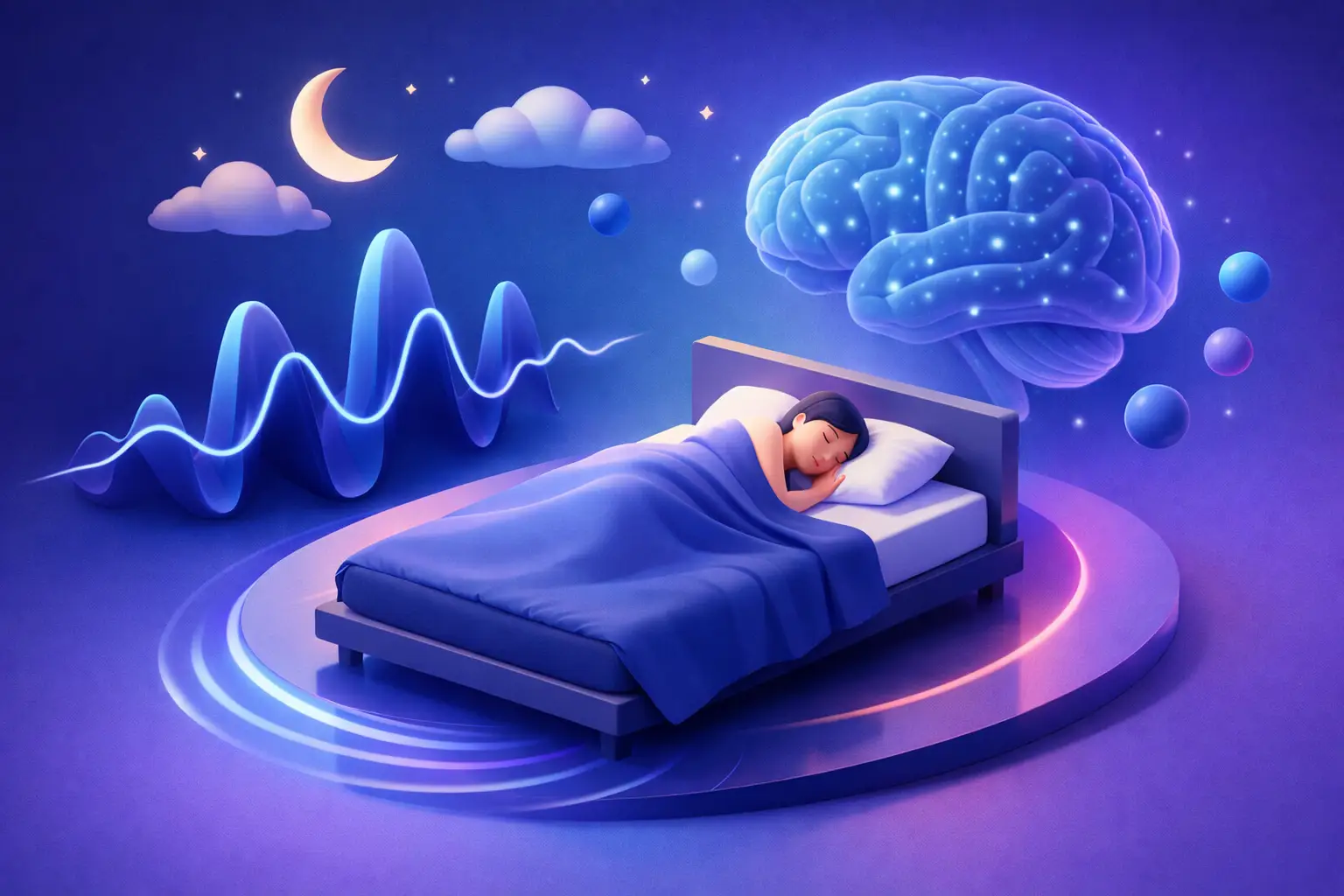
Have you ever "slept" for 8 hours but woke up feeling like you were hit by a truck? The problem isn't the quantity of your sleep—it's the frequency.
The High-Beta Trap In our 24/7 digital world, your brain often stays "stuck" in a high-frequency state even after you close your eyes. This is called "High-Beta" activity. If your brain doesn't downshift into Delta (0.5–4 Hz), it cannot perform vital maintenance like tissue repair or flushing out metabolic waste.
1.5 Hz: The Deep Sleep Engine The 1.5 Hz frequency is a specific sweet spot in the Delta range. It is the "Manual Override" for your nervous system. By using the Deep Sleep preset on Hertzbox Pro, you are physically guiding your brain away from the day's stress and into the "Neural Cleanup" zone.
What Happens at 1.5 Hz?
Tissue Regeneration: Your body releases the most growth hormone in this state.
Memory Consolidation: Your brain moves the day's data from short-term to long-term storage.
Cortisol Flush: Your stress hormones reach their lowest point, allowing your heart rate to stabilize.
How to use it: Put on your headphones, hit the Deep Sleep button, and keep the volume low—just enough to feel the subtle pulse. Let the 1.5 Hz engine do the work of slowing your mind down for you.
If you've seen a track labeled 1.5 hz deep sleep, the promise is obvious: slower brain activity, deeper rest, better recovery. That idea is compelling for anyone running hard all day and waking up feeling like sleep never fully did its job. But the real value comes from understanding what 1.5 Hz is actually pointing to, what binaural beats can and cannot do, and how to use this kind of audio in a way that supports sleep instead of turning it into another performance project.
What 1.5 Hz deep sleep is trying to target
A 1.5 Hz frequency sits in the delta range, which is associated with the slowest brainwave activity. Delta is the territory most people connect with deep, dreamless sleep, physical restoration, and the kind of overnight reset that leaves you feeling less mentally scraped out the next day.
That does not mean your brain becomes a steady 1.5 Hz machine all night. Real sleep is dynamic. You move through stages, cycle in and out of lighter and deeper sleep, and your brain activity shifts across the night. So when a binaural beat track uses 1.5 Hz, it's not claiming your entire brain will lock into that exact number for eight straight hours. It's aiming to encourage a brain state associated with deep sleep.
That distinction matters. If you expect precision-lab outcomes from a consumer audio track, you'll probably be disappointed. If you see it as a tool that may help nudge your system toward slower, calmer patterns, you're thinking about it the right way.
Why people are drawn to 1.5 Hz for sleep
Most adults don't need more advice about "sleep hygiene." They need something that helps them actually stop carrying daytime speed into bedtime. That's where low-frequency sleep audio gets attention.
A 1.5 Hz deep sleep track appeals because it speaks to a specific outcome: slowing down enough to reach more restorative sleep. For people with busy minds, late-night stress, or the feeling of being physically tired but mentally switched on, that specificity is a big part of the attraction.
The other reason is simplicity. You don't have to learn a technique, count breaths for 20 minutes, or commit to a long routine. You press play, lower the lights, and give your brain a cleaner signal than the one it gets from notifications, rumination, or streaming something half-watched in bed.
How binaural beats fit into the picture
Binaural beats work by sending slightly different tones to each ear. Your brain processes the difference between those tones as a perceived beat. In the case of sleep audio, that perceived beat may be set in a low range such as 1.5 Hz.
The theory is that this can support entrainment, or a shift toward the targeted brainwave pattern. Some users report that it helps them relax faster, settle racing thoughts, or sleep more deeply. Others notice only a mild calming effect, and some notice very little at all.
That's the honest trade-off. Binaural beats are promising for some people, but they are not a guaranteed sleep switch. Your stress load, stimulant intake, bedtime habits, sensitivity to sound, and overall sleep health still matter.
What 1.5 Hz deep sleep can realistically help with
The strongest case for this kind of audio is not that it magically manufactures perfect sleep. It's that it can create a better runway into sleep.
If your biggest problem is mental momentum, low-frequency audio may help reduce internal noise. That can make it easier to stop rehearsing tomorrow's tasks, replaying awkward conversations, or drifting into that frustrating zone where your body is still but your mind is sprinting.
For some listeners, the benefit continues after sleep onset. A consistent, low-distraction sound environment can reduce the impact of minor background noises and support a more settled night. For others, the track works best only at the beginning and becomes less useful once they're asleep.
It also depends on your sleep issue. If you struggle mainly with falling asleep, 1.5 Hz audio may feel more helpful than if you have frequent wake-ups caused by pain, sleep apnea, hormonal shifts, or a highly irregular schedule. Audio can support the process, but it can't correct every root cause.
What it does not mean
A lot of frequency-based wellness content gets overhyped. Let's clear that up.
1.5 Hz deep sleep does not mean you can replace healthy sleep habits with headphones. It does not mean one track will override chronic stress, alcohol-related sleep disruption, or a bedroom setup that keeps your nervous system alert. And it does not mean every listener will have the same experience.
It also does not mean "more extreme equals better." Lower is not always stronger. Some people respond well to very low delta-targeted tracks. Others sleep better with softer ambient support or a track that eases them down gradually instead of aiming immediately at a very slow beat.
This is where a performance mindset helps, as long as you use it wisely. Treat sleep audio like a tool you test, not a miracle you assume.
How to use a 1.5 Hz deep sleep track effectively
Timing matters more than most people think. If you start a sleep track while still scrolling, replying to messages, or keeping bright overhead lights on, you're working against the signal. Give the audio a real chance by lowering stimulation first.
Headphones are usually needed for true binaural beats because each ear has to receive a slightly different tone. If sleeping in headphones is uncomfortable, use the track during your wind-down period rather than all night. That alone may be enough to help you cross into sleep more smoothly.
Volume should stay low. Sleep audio is not supposed to dominate your attention. If it feels intrusive, sharp, or mentally demanding, it is too loud or simply not the right track for you.
Consistency is another factor. One night tells you very little. Try NeuroHrzFlow Protocol for several evenings under similar conditions. Your brain often responds better to repetition than novelty, especially around sleep.
When 1.5 Hz deep sleep audio works best
This kind of audio tends to fit best for people who are mentally overclocked. Think professionals who close the laptop but can't shut off mentally, students who carry study stress into bed, or entrepreneurs whose brains keep generating new tasks at midnight.
It's also a smart fit for people who want non-invasive support. No supplements, no complicated protocol, no extra gear beyond a phone and headphones. That's part of why audio-based tools have become so appealing in the wellness space.
At Hertzbox Pro, that outcome focus is the whole point. The goal isn't to make sleep feel mystical. It's to give your brain a cleaner path into a calmer state.
What to watch for before making it a nightly habit
If audio helps you relax but you become dependent on one exact track, volume level, or setup, that can backfire when you're traveling or sleeping somewhere new. The better goal is support, not dependence.
You should also pay attention to how you feel the next day. The only metric that really matters is whether your sleep feels more restorative over time. Faster sleep onset is great, but if you wake groggy, irritated, or unrested, the track may not be helping as much as you think.
And if your sleep problems are persistent Try NeuroHrtz Protocol, intense, or linked to snoring, gasping, anxiety, or major daytime fatigue, bigger issues may be in play. Audio can be useful, but it should not become a way to ignore symptoms that deserve more attention.
Is 1.5 Hz deep sleep the best sleep frequency?
Not automatically. That's one of the most common misconceptions.
Some listeners do well with 1.5 Hz because it aligns with a very slow, heavy sleep target. Others prefer tracks that start higher and gradually descend, which can feel more natural for the transition from wakefulness to sleep. And some people simply respond better to gentle ambient sound layered with low-frequency beats than to a more obvious tonal structure.
The best sleep frequency is the one that helps your nervous system settle without creating irritation, expectation, or mental effort. That may be 1.5 Hz. It may be close to it. Or it may be a broader sleep-oriented sound design rather than a single number.
The smart move is to stay results-focused. If a track helps you fall asleep with less friction and wake up with more recovery, it is doing its job.
Sleep is still one of the highest-return forms of mental optimization available. When your nights improve, focus sharpens, mood steadies, and your threshold for stress gets stronger. If 1.5 Hz deep sleep audio helps create that shift, even modestly, that's not hype. That's leverage.